Why Glass Blocks UV Light but Lets Visible Light Through: A Deep Dive Into the Band Gap
In October 2026, a technician at the University of Sheffield named Lisa Hollands did something nobody had managed in 1,600 years. She made a piece of glass that changes colour the way a Roman masterpiece does.
The original is the Lycurgus Cup, a fourth-century drinking vessel in the British Museum. Lit from the front, it is jade green. Put a light behind it and it turns ruby red. The Romans who made it had no idea why. It took until 1990, when scientists put fragments under an electron microscope, to find the answer: specks of gold and silver about 70 nanometres across, scattered through the glass, smaller than the wavelength of light itself.
Hollands cracked the recipe by trial, error and patience. Glass artist Elliot Walker turned her dichroic glass into a sculpture that debuted at Sheffield’s Millennium Gallery in November 2026, before moving to the university’s Turner Museum of Glass. It is a lovely story on its own. It is also the perfect doorway into a stranger question, one you can test from your own sofa: why does the glass in your window let sunlight through, yet stop the very rays that burn your skin?
The same material does both. The reason is a single number in quantum physics, and it also explains fibre-optic cables, the colour of old bottles, why your car turns into an oven in summer, and why medieval cathedral windows are not slowly melting down their frames. Our Complete guide to why glass is transparent covers the short version; this is the deep version.
First, what glass actually is
Glass starts as sand — mostly silicon dioxide, SiO2 — melted at around 1,700°C with soda ash and lime, then cooled so fast its atoms never get the chance to arrange themselves into a tidy crystal. What freezes in place is a disordered network: each silicon atom bonded to four oxygens, each oxygen bridging two silicons, a rigid three-dimensional tangle with no repeating pattern.
Physicists call this an amorphous solid. It is not a liquid, however slowly. Its atoms are locked. What matters for light is not the disorder itself but what the disorder does to the electrons. In glass, every electron is bound tightly to its atom, and the energy needed to kick one into a higher state is enormous by the standards of everyday light.
The band gap: the one number that decides everything
Light arrives as photons, packets of energy. A photon’s energy depends on its colour: red light carries about 1.6 electron volts, violet about 3.1. Ultraviolet starts around 3.1 and climbs past 100. Infrared sits below red, under 1.6.
Inside any solid, electrons live in allowed energy bands, separated by forbidden zones called band gaps. A photon can only be absorbed if its energy is enough to lift an electron across the gap. If it falls short, the photon has nowhere to go. It passes through.
Pure silica’s band gap is about 9 electron volts. Visible light, at 1.6 to 3.1 eV, is nowhere near enough. So it passes through, and glass is transparent. Ultraviolet, at 3.1 eV and up, reaches the threshold — in ordinary soda-lime window glass, impurities pull the practical cutoff down to around 300 nanometres — and gets absorbed. That is the whole trick, and it falls out of a single comparison of energies:
| Material | Band gap | What visible light does |
|---|---|---|
| Window glass (silica) | ~9 eV | Passes straight through |
| Diamond | 5.5 eV | Passes through — a transparent crystal |
| Silicon | 1.1 eV | Absorbed — which is why solar panels work |
| Metals | No gap at all | Absorbed or reflected — opaque |
Silicon’s small gap is the reason a solar panel can drink sunlight while a window ignores it. The same rule, different numbers. Glass is transparent not because it is empty but because its electrons demand a price visible light cannot pay.
Why light slows down and bends
Transparency does not mean light ignores glass. Entering a window, light slows from 300,000 kilometres per second in air to roughly 200,000 in glass. The ratio is the refractive index, about 1.50 for ordinary window glass, and the slowdown bends the ray — refraction, the effect that makes a straw in a drink look broken.
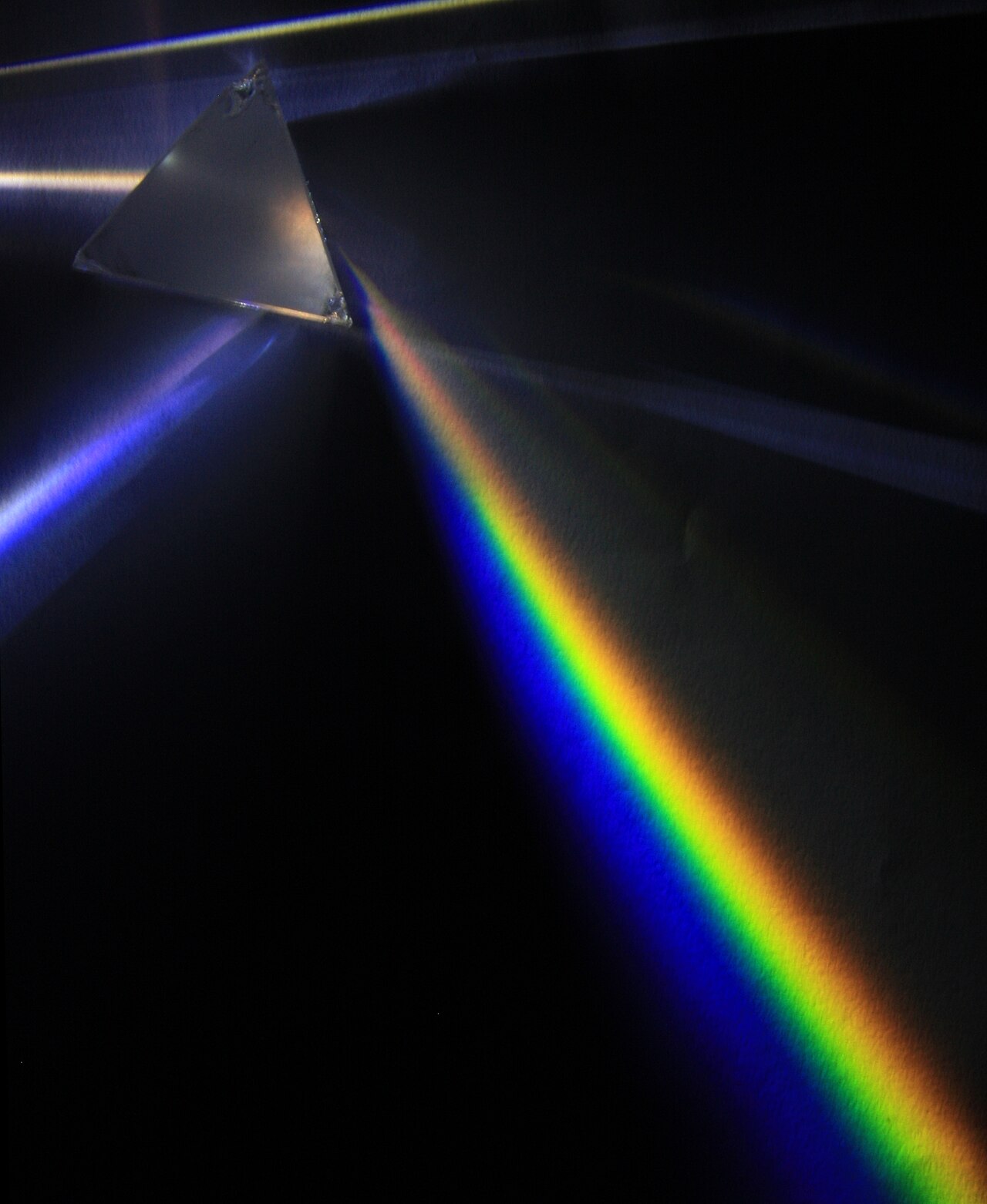
The slowdown is not equal for all colours. Violet light is slowed a fraction more than red, so it bends a fraction further. Send white light through a prism and the colours fan out into a spectrum, each wavelength taking its own angle. Isaac Newton did this with a prism in the 1660s; a flint-glass prism still does it today, and the photograph of that fan of colour is the prettiest proof in optics that light is not one thing but a range of energies.
About 4% of light reflects off each surface of a window instead of passing through — the reason you can see your own faint reflection in a dark window, and the reason camera lenses carry anti-reflective coatings. The rest goes through, slowed, bent, and otherwise unchanged.
Why does glass block UV light — and what that costs you
Ordinary window glass transmits roughly 90% of light above 350 nanometres and blocks over 90% below 300. In plain terms: most of the ultraviolet that reaches us is divided into UVA (315–400 nm), UVB (280–315 nm) and UVC (100–280 nm). Glass stops essentially all the UVC and most of the UVB, and lets a good share of the UVA through.
That split has everyday consequences. You cannot get sunburned sitting behind a closed window, because sunburn is mostly a UVB injury. You also cannot make vitamin D there, because vitamin D synthesis needs the same UVB. Museums exploit the cutoff on purpose: UV-blocking glazing protects paintings and textiles from the wavelengths that fade pigments, and laminated car windscreens block about 99% of UV altogether. The glass in your spectacles does the same job quietly every day.
None of this is because glass was designed to be a filter. It is a side effect of the band gap — the same wall that stops visible light from being absorbed stops the lower-energy half of the ultraviolet from getting through either, while the higher-energy half crashes into it.
The other end of the spectrum: why glass traps heat
Go the other direction, below red light, and glass fails in the opposite way. Far-infrared radiation — the heat glow given off by warm objects — has too little energy to excite electrons, but it matches a different set of motions: the vibrations of the silicon-oxygen bonds themselves. The glass absorbs it. A window is transparent to the sunlight coming in and nearly opaque to the heat trying to get back out.
You have felt this in a parked car. Sunlight passes through the windscreen, warms the seats and dashboard, and those surfaces re-radiate their heat as infrared, which the glass will not pass. The temperature climbs. A greenhouse works on the same principle, and so, on a planetary scale, do greenhouse gases — the same infrared-trapping physics that warms a car is part of why a warming Arctic can still deliver colder winters, as the jet stream wobbles and Arctic air spills south.
Engineers have learned to tune this behaviour. Low-emissivity, or low-E, window coatings are microscopically thin layers of metal oxide that reflect infrared back into the room in winter and back outside in summer, while staying transparent to visible light. It is the band gap and the vibrational spectrum, managed like a budget: let the visible in, keep the infrared where you want it.
Why glass has colour at all
Pure glass is colourless. Every coloured glass you have seen is glass with something deliberately — or accidentally — dissolved in it. Iron, the most common impurity in sand, gives old window glass its faint green tint and makes bottle glass green or brown. Cobalt makes a deep blue. Manganese was once added to cancel the green of iron, and old manganese glass turns purple after decades in sunlight.
The most spectacular case is the Lycurgus Cup. Analysis published by Freestone and colleagues in Gold Bulletin in 2007 found about 330 parts per million of silver and 40 of gold in the glass, present as alloy nanoparticles roughly 70 nanometres across. Particles that size interact with light through surface plasmon resonance: their free electrons slosh back and forth in step with the incoming light wave, absorbing and scattering some wavelengths far more strongly than others. The cup’s particles scatter green light back toward your eye while letting red light pass through — so the same object is green by reflection and red by transmission. It is nanotechnology from the fourth century, made by people who could not have known what a nanoparticle was.
A 2026 study in Applied Physics A modelled the effect with Monte Carlo photon transport and machine learning, reproducing the cup’s exact transmitted red and reflected green. And in the same year, the Sheffield replication showed the recipe itself can be recovered by a patient craftsperson. The Romans stumbled on plasmonics; we are only now catching up to them.

The same physics, stretched to its limit: fibre optics
If glass is so transparent, why can’t you see through a thick block of it? You can, but only just — every metre of ordinary glass absorbs and scatters a little light, and the losses add up. In the 1960s the best optical glass lost about 1,000 decibels per kilometre. A signal sent down it would be gone within metres.
In 1966, Charles K. Kao showed the loss was not the glass itself but trace impurities — iron, copper and trapped water — and predicted that purifying silica below one part per million would cut the loss below 20 dB/km. In 1970, researchers at Corning made the first low-loss fibre. Kao won the Nobel Prize in Physics in 2009 for the insight. Today a standard silica fibre loses about 0.2 decibels per kilometre at a wavelength of 1,550 nanometres — 95% of the light still there after a kilometre — and the signal travels by total internal reflection, bouncing down a core thinner than a human hair.
That is the band-gap story pushed to its extreme: glass so pure that almost nothing in it can absorb light, guiding it across oceans. Every video call, every undersea cable, rides on the fact that a photon of the right energy cannot find an electron willing to take it.
Is glass a liquid? No — and the windows prove it
The most repeated claim about glass is that it is a very slow liquid, and that medieval cathedral windows are thicker at the bottom because the glass has flowed downhill over centuries. It is poetic, and it is wrong.
Edgar Zanotto tested it in a 1998 paper in the American Journal of Physics, “Do Cathedral Glasses Flow?” Using measured viscosity curves, he calculated how long ordinary window glass would need to sag by a noticeable amount at room temperature. The answer was longer than the age of the universe — the viscosity of glass at room temperature is around 10²⁰ pascal-seconds, against about 10 for honey and 0.001 for water. Cathedral glass has not flowed. It has not had time.
Old windows are uneven because making flat glass used to be hard. In the crown-glass process, a blob of hot glass was spun into a disc that came out thicker near the centre; in the cylinder process, a blown tube was slit and flattened, and the thickness varied along its length. Glaziers cut panes from these sheets and usually put the heavier edge at the bottom, for stability. That is why so many old panes are thick at the bottom — and why some are thick at the top or the side, which gravity could never explain.
Why this matters, and what happens next
Glass looks like a solved material. It is not. The same physics in this article is still being engineered. Phone screens use chemically strengthened glass — Gorilla Glass and its rivals — in which large potassium ions are swapped for smaller sodium ions at the surface, squeezing the outer layer into compression so cracks cannot spread. Smart windows use electrochromic coatings that change tint at the touch of a button, flipping the band gap’s consequences on demand. And fibre research has moved to hollow-core designs, where light travels mostly through air inside a glass structure, pushing losses lower still.
The deeper point is the one the Lycurgus Cup makes best. A material’s behaviour is not a list of properties to memorise. It is the consequence of a few numbers — the band gap, the refractive index, the vibrational frequencies — working themselves out across every wavelength of light. Change the numbers, by adding forty parts per million of gold or removing one part per million of iron, and the same sand becomes a red-glowing cup, a window, a solar panel, or a cable under the Atlantic. The physics does not change. Only the recipe does.
If you want the short version first, the basics are in our Complete guide. This was the long version: why a window is a filter, a lens, a mirror and a trap all at once — and why a cup made sixteen centuries ago still has something to teach the people who finally learned to copy it.
Frequently asked questions
Why can I see through glass but not through a wall?
A wall’s materials have small band gaps or free electrons, so visible light is absorbed or reflected. Glass has a band gap of about 9 electron volts, far above the 1.6–3.1 eV that visible photons carry, so the light passes through unabsorbed.
Can you get sunburned through a window?
Almost never. Ordinary window glass blocks most UVB, the rays that cause sunburn, and all UVC. It does let some UVA through, so you are not fully shielded, but a sunburn behind closed glass is very unlikely.
Why does glass block heat but let light in?
Visible light passes because its photons cannot bridge the band gap. Far-infrared, the heat glow from warm surfaces, is absorbed by the vibrations of the silicon-oxygen bonds instead. Glass is transparent to incoming sunlight and nearly opaque to outgoing heat.
Is glass a liquid?
No. Glass is an amorphous solid — its atoms are disordered like a liquid’s but locked in place. Edgar Zanotto calculated in 1998 that cathedral window glass would need far longer than the age of the universe to flow noticeably at room temperature.
Why is some glass green?
Iron impurities in the sand. Even tiny amounts of iron absorb red light and leave a green tint, which is why old windows and bottle glass often look green. Glassmakers add manganese or use low-iron sand to make extra-clear glass.
Why does fibre-optic glass carry light for kilometres?
It is silica purified to below one part per million of light-absorbing impurities, so almost nothing inside can absorb the signal, and the light is trapped by total internal reflection. Modern fibre loses only about 0.2 decibels per kilometre at 1,550 nanometres.