Why Is Space Black If the Sun Is Shining?
On 7 December 1972, the crew of Apollo 17 looked back at their home planet and took one of the most famous photographs ever made. The Blue Marble shows Earth in full: blue oceans, brown continents, white swirls of cloud. And around it, nothing but pure black. The Sun was shining directly on the spacecraft. Sunlight was pouring past it in every direction. Yet the sky was black.
It is a fair question, and it bothers almost everyone who stops to think about it. If the Sun is shining, and space is full of stars, why is space black? Why isn’t the sky out there bright?
The answer comes in two parts. First, light itself is invisible: you only see it when it bounces off something into your eyes, and space is almost entirely empty. Second, the stars, for all their number, cannot fill the sky — and the reason they can’t tells us something deep about the universe itself: it had a beginning, and it is still expanding.
You cannot see light itself — only what it hits
Shine a torch across a dark room and you will see a bright spot where the beam lands on the wall. But the beam itself, crossing the air between the torch and the wall, is invisible — unless the room is dusty or smoky. Then the beam appears as a glowing cone, because dust and smoke particles scatter some of the light sideways, into your eyes.
That is how vision works. Light travels in straight lines, and a ray of light passing beside your head is completely undetectable to you. You only see light when photons enter your eye — either directly from the source, or after bouncing off something. A sunbeam in a dusty room is visible because the dust is doing the bouncing. Clean air scatters so little light that the beam disappears.
Space is the cleanest room imaginable. Between the planets there are only a few atoms in every cubic centimetre — about one hydrogen atom per cubic centimetre in interstellar space, against roughly 27 quintillion molecules in the same volume of air at sea level on Earth. Sunlight streams through that near-vacuum at 300,000 kilometres per second, taking about 8 minutes and 20 seconds to reach Earth, and almost none of it is scattered sideways. That eight-minute journey is also the fastest possible one: nothing can travel faster than light. Look away from the Sun and there is no light coming toward your eyes at all — so you see black.
This is also why a sunbeam feels so strange in photographs taken from orbit. The light is real, and it is intense — unfiltered sunlight in space is brighter than anything on Earth. But brightness is not something light has on its own. Brightness is what happens when light meets matter. Glass shows the other side of the same coin: light passes straight through it because its electrons cannot absorb visible light — the full explanation is in our guide to why glass is transparent.
Earth’s blue sky is the exception, not the rule
On Earth, the sky is blue for exactly the reason space is black: scattering. Air molecules are much smaller than the wavelength of visible light, and they scatter short blue wavelengths far more strongly than long red ones — roughly ten times more strongly, because the strength of this Rayleigh scattering rises with the fourth power of the frequency. Sunlight entering the atmosphere is scattered in every direction, and the scattered blue light reaches your eyes from the whole sky at once. The sky glows blue because the air itself is glowing, lit from within by scattered sunlight.
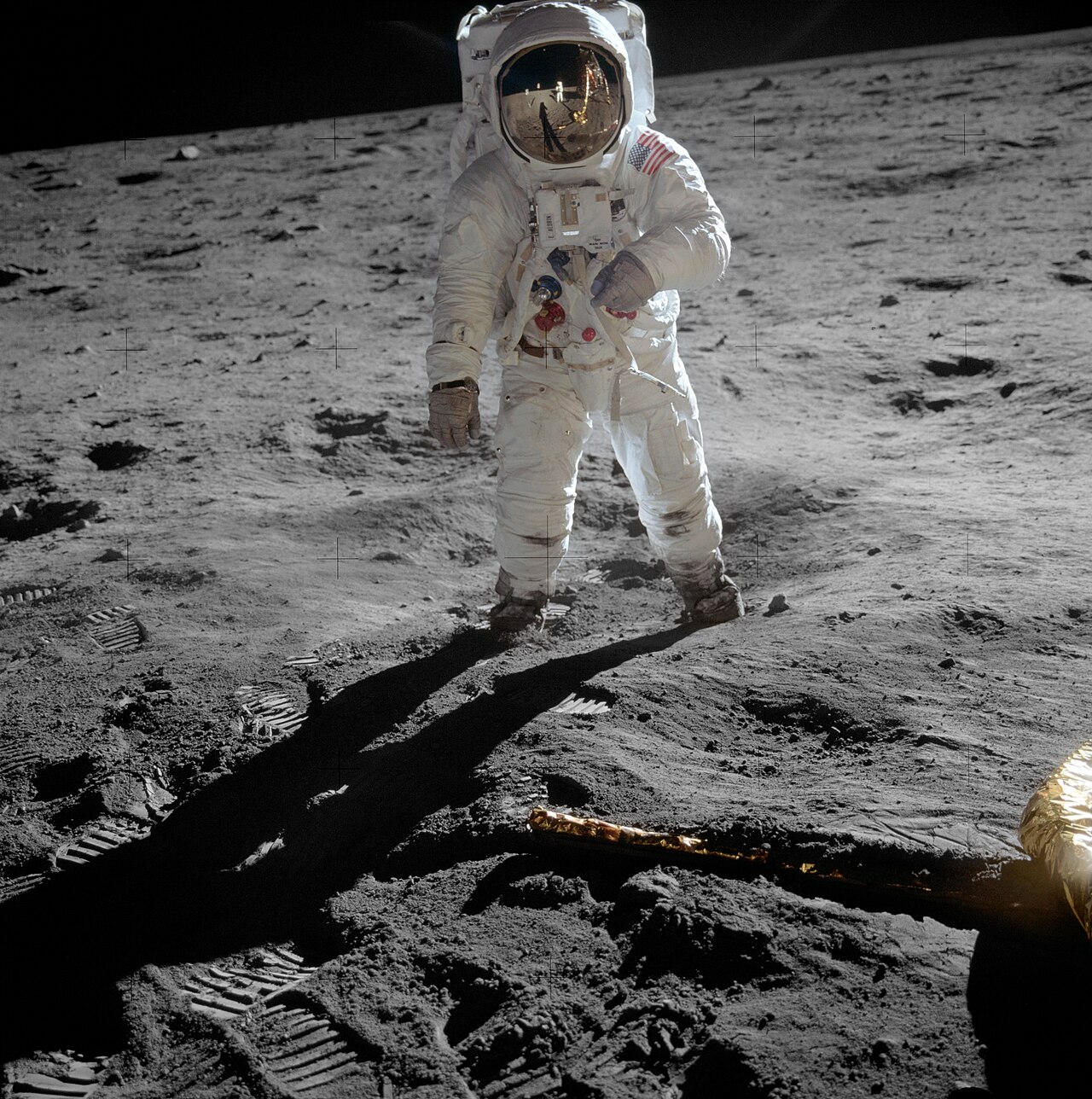
Take the air away and the blue goes with it. The Moon has essentially no atmosphere, and Apollo astronauts standing in full sunlight saw a black sky at lunar noon. The Sun blazed, the grey lunar surface was brilliantly lit, shadows were razor sharp — and above the horizon there was nothing but black, with stars visible in the daytime. The photograph of Buzz Aldrin on the Moon, taken by Neil Armstrong on 20 July 1969, shows it plainly: a sunlit astronaut, a sunlit landscape, and a sky as black as midnight.
From orbit the same effect is visible in reverse. Photographs from the International Space Station show Earth wrapped in a thin blue line — the atmosphere, glowing where sunlight scatters through it — and above that line, blackness. The blue is not the sky itself. It is a thin shell of gas, only a few dozen kilometres thick, doing all the scattering. Step outside it and the universe is dark.
The same physics colours our sunsets. At sunset, sunlight crosses much more atmosphere to reach your eyes, and so much blue is scattered away along the way that only the reds and oranges survive. A red sunset and a blue noon sky are the same scattering at different doses.
But what about all the stars?
The first part of the answer explains the space near the Sun. But it leaves a harder question. Space contains hundreds of billions of stars in our galaxy alone, and hundreds of billions of galaxies beyond it. Each star is a sun. Why doesn’t their combined light fill the sky?
This puzzle is called Olbers’ paradox, after the German astronomer Heinrich Olbers, who formalised it in 1823 — though Kepler, Halley and Chéseaux had all worried at it before him. The argument is simple. In a universe that is infinite, infinitely old and unchanging, every line of sight from Earth should eventually end on the surface of a star, just as every line of sight in an endless forest ends on a tree trunk. A distant star looks dimmer, but there are more stars at greater distances, and in a static, infinite universe the two effects cancel exactly. The whole night sky should blaze as bright as the surface of the Sun. It does not. So at least one of the assumptions must be wrong. Modern cosmology says two of them are.
The first is the age of the universe. The universe is about 13.8 billion years old, so light has only had 13.8 billion years to travel. The observable universe is about 93 billion light-years across — wider than its age in light-years because space itself has expanded while the light was travelling — but it is still finite. Light from stars beyond that horizon simply has not had time to reach us. There are not infinitely many stars pouring light at us, only the ones inside our observable bubble.
The second is that the universe is expanding. As space stretches, it stretches the light travelling through it, shifting it to longer, redder wavelengths. Light from the most distant galaxies is redshifted so far that it has moved out of the visible spectrum entirely, into the infrared. The stars are still shining; their light simply arrives in a form our eyes cannot see. Our eyes detect a narrow slice of the electromagnetic spectrum, roughly 380 to 750 nanometres, and most of the universe’s light falls outside it.
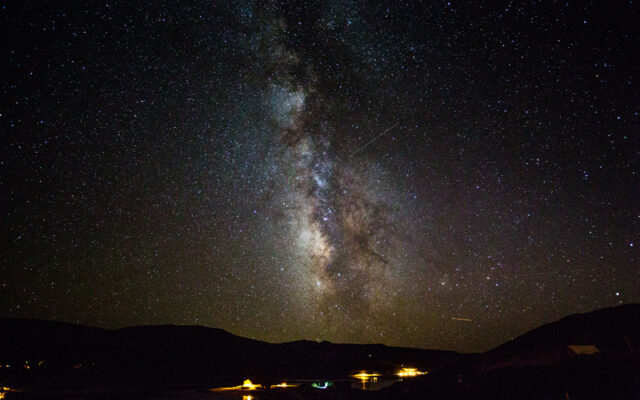
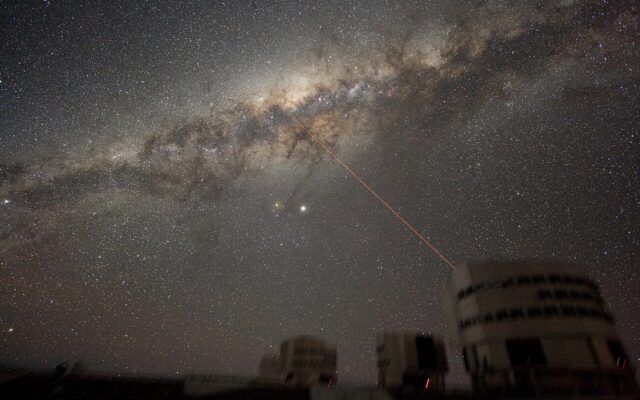
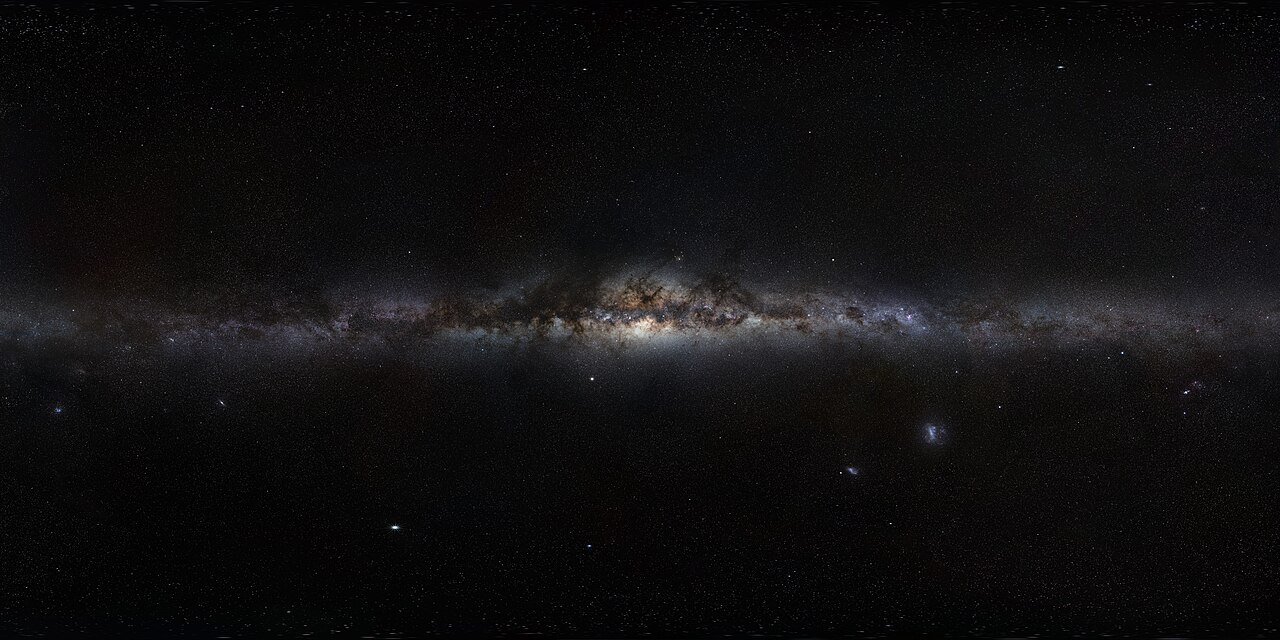
And then there is sheer emptiness. Stars are far apart. Our galaxy averages only about 0.004 stars per cubic parsec — a parsec is 3.26 light-years — so most lines of sight from Earth cross vast stretches of nearly empty space before reaching any star. Interstellar dust absorbs and dims some of the light that does set out toward us. The Milky Way, seen from a dark site on Earth, looks like a glowing band precisely because we are looking along the crowded plane of our own galaxy; the European Southern Observatory’s 360-degree panorama of the Milky Way shows that band in full. Look away from it, and the sky is mostly empty black.
So the darkness of the night sky is not a failure of the stars. It is evidence. A dark sky tells us the universe had a beginning and is still expanding. If the sky were bright, cosmology would be a very different science.
Space is not perfectly black — just black to your eyes
There is a final twist: space is not actually dark. It only looks dark to human eyes. The universe is filled with the cosmic microwave background, the cooled afterglow of the Big Bang, which bathes every point in space at a temperature of 2.725 kelvin — about minus 454.8 degrees Fahrenheit. But that glow is microwaves, far outside the range our eyes can detect. If human eyes could see microwaves, the sky would glow faintly in every direction, day and night.
There are other faint glows too. Zodiacal light is sunlight scattered by interplanetary dust, visible as a faint pyramid of light above the horizon after sunset or before sunrise from a truly dark site. Airglow is a faint emission from Earth’s own upper atmosphere. And every part of the sky is crossed by starlight — it is simply too faint, spread across too much darkness, for our eyes to register as a bright background.
Telescopes that see beyond visible light reveal the bright universe our eyes miss. Infrared telescopes pick up the redshifted light of distant galaxies. Radio telescopes map the microwave background in detail. X-ray telescopes see the hot gas between galaxies glowing. The universe is full of light. Our eyes just sample a thin slice of it.
What astronauts actually see
Apollo crews described the same scene every time: a black sky, a blazing Sun, and stars visible even in lunar daytime. On the Moon there is no twilight and no blue hour — the Sun appears suddenly at dawn and the sky stays black. The International Space Station’s Cupola windows show the same view: black sky above a thin blue atmosphere, stars visible when the station passes into Earth’s shadow and the crew’s eyes adapt. Those stars, by the way, do not twinkle in space: twinkling is an effect of Earth’s atmosphere, as our guide to why stars twinkle but planets don’t explains.
One detail confuses people: why are there no stars in the Apollo photographs? The answer is exposure, not absence. The lunar surface in direct sunlight is brilliantly bright, and the cameras were set for that daylight scene — fast shutter speeds, small apertures. Stars are far too faint to register in a fraction of a second at those settings. It is the same reason your phone photographs a brightly lit room perfectly but records the night sky as black: the camera is exposing for the bright thing, and the faint thing vanishes. Long exposures from orbit, or with eyes fully adapted to darkness, bring the stars out.
The lack of air has other consequences for astronauts. With no atmosphere to filter it, sunlight in space carries unfiltered ultraviolet radiation, and temperatures swing violently: the lunar surface reaches about 127 degrees Celsius in direct sunlight and falls below minus 170 degrees Celsius in shadow. Spacesuits and spacecraft are engineered around exactly that — blazing light in a black sky.
The short answer
Space looks black for two reasons, and both are about light meeting matter. First, sunlight is invisible while it travels: with almost nothing in space to scatter it sideways into your eyes, you see black in every direction except directly at the Sun or at something the Sun is lighting up. Earth’s blue sky is the exception — a thin shell of air doing the scattering. Second, the stars cannot fill the sky because the universe is only about 13.8 billion years old and is still expanding: most starlight either has not had time to reach us or arrives stretched beyond visible light.
The blackness, in other words, is not the absence of light. Space is full of light. It is the absence of something for the light to bounce off — and a reminder that the darkness above us is one of the oldest clues we have about how the universe began.
Why is space black but Earth’s sky blue?
Earth’s sky is blue because air molecules scatter sunlight, mostly the blue wavelengths, in every direction — the whole sky glows. Space has almost no air or dust to do that scattering, so sunlight travels straight past your eyes and the sky stays black.
Is space completely black?
Not quite. The universe is filled with the cosmic microwave background, the cooled afterglow of the Big Bang at 2.725 kelvin, plus faint zodiacal light and starlight. All of it is either outside the visible spectrum or too faint for human eyes to see as a bright background.
Why can’t you see stars in the Apollo Moon photos?
Because of exposure. The cameras were set for the brilliantly sunlit lunar surface, with fast shutter speeds. Stars are far too faint to register at those settings. The astronauts could see stars with their own eyes — the cameras simply were not exposing long enough to record them.
Why is the Moon’s sky black even at noon?
The Moon has essentially no atmosphere, so there is nothing to scatter sunlight and make a sky. The Sun shines directly and the surface is brightly lit, but look away from the Sun and there is no scattered light reaching your eyes — only black.
If space is black, why can we see stars at night?
Because we are looking directly at the stars themselves — their light travels straight into our eyes. The darkness between them is the empty space in between, where there is nothing to scatter light toward us. We see the lights, not the space around them.