Olbers’ Paradox Explained: Why the Night Sky Is Dark — A Deep Dive
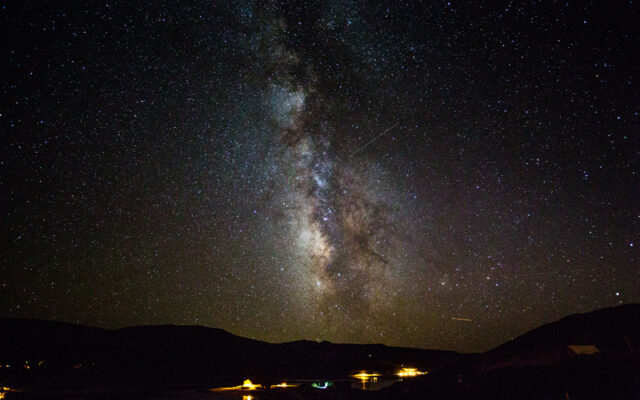
Step outside on a clear, moonless night, far from city lights, and the sky is black between the stars. That darkness is one of the strangest facts in science — stranger than it looks, and stranger than most people realise. Because if the universe were infinite, eternal and filled with stars in every direction, the night sky should not be dark at all. It should blaze as brightly as the surface of the Sun, everywhere, all the time.
That contradiction is Olbers’ paradox, and it took astronomers nearly four centuries to settle it. The answer turns out to be one of the strongest pieces of everyday evidence that the universe had a beginning — and, in the last few years, a spacecraft flying beyond Pluto has finally measured exactly how dark the darkness is. This is the long version. The short version is in our Complete guide to why space looks black.
The paradox, stated plainly
Imagine the universe as it was understood for most of history: infinite in size, eternal in age, and filled with stars spread more or less evenly through space. Now pick any direction and look. Your line of sight travels outward, past nearby stars, past distant ones, past galaxies beyond those — and in an infinite universe, it can never run out of stars. Sooner or later, in every direction, your gaze must land on the surface of a star.
If that is true, the whole sky should be covered with star surfaces, edge to edge, with no gaps. And a surface covered in stars has the brightness of a star’s surface — roughly 5,800 kelvin, the temperature of the Sun’s visible surface. The night sky should look like the face of the Sun. It does not. That is the paradox.
The puzzle is older than the astronomer it is named after. Thomas Digges raised it in 1576. Johannes Kepler wrestled with it in 1610. Edmond Halley and the Swiss astronomer Jean-Philippe Loys de Chéseaux worked on it in the 1700s. Heinrich Wilhelm Olbers restated it in the clearest form in 1823, and his name stuck — even though, as the cosmologist Edward Harrison later pointed out, Olbers was far from the first to pose the problem, and his own thinking on it was not particularly valuable. The paradox survived every one of them. It was not properly resolved until the twentieth century, and the resolution is still being measured today.
Two versions of the same puzzle
The paradox actually comes in two forms, and they have different resolutions. It helps to keep them apart.
The first is the flux form, or the shell argument. Picture the universe as a series of thin, onion-like shells centred on Earth, each the same thickness. A shell twice as far away has four times the area, so it holds four times as many stars. But each of those stars is twice as distant, so each looks one quarter as bright — light spreads out following the inverse-square law. Four times as many stars, each a quarter as bright: the two shells deliver exactly the same amount of light to your eye. And so does every other shell, out to infinity. Add up infinitely many equal contributions and the total is infinite. The sky should be infinitely bright.
The second is the brightness form, or the line-of-sight argument. Forget the total and follow a single ray. In an infinite, uniform universe it must eventually hit a star, the way that standing in a large enough forest, every direction you look ends on a tree trunk.
That forest is the right image, and it is worth pausing on. Walk into a dense wood and the trees close around you: trunks in every direction, near ones hiding far ones, until the whole horizon is wood. The gaps between the nearest trees are filled by trees behind them. Stars should do the same thing to the sky.
How far would a ray of light have to travel before it hit a star? The stars are so sparse that the answer is of the order of 10²⁴ light-years — a million billion billion kilometres, vastly further than the observable universe extends. That number is the key to the whole puzzle, and we will come back to it. But in a universe with no edge and no beginning, distance is no obstacle: given infinite space, every sightline eventually finds its star.

How bright should the sky be?
Chéseaux did the arithmetic in 1744, and the number is startling. In an infinite universe of Sun-like stars, the starlight falling on Earth should be about 90,000 times brighter than sunlight. Not 90,000 times brighter than a moonlit night — 90,000 times brighter than noon sunshine.
The line-of-sight argument gives the same conclusion in a different way. If every point of the sky were covered by a star’s surface, the sky would have the surface brightness of an average star. Surface brightness, unlike total brightness, does not fall with distance: a star looks smaller when it is further away, but each square arcsecond of its disc is just as bright. So the whole sky would glow at roughly 5,800 kelvin — and the Earth, bathed in that light from every direction at once, would be heated to about the same temperature. There would be no night, no darkness, and no Earth as we know it.
The observed sky is, by comparison, almost perfectly dark. Something in the assumptions has to give. At least one of the three — infinite, eternal, uniform — must be false.
Four centuries of wrestling with the dark
The history of the paradox is a catalogue of clever ideas that did not work, and each failure taught astronomers something.
Digges, in 1576, was the first to see the problem clearly: in an infinite universe the stars should fill the sky. Kepler, in 1610, used the darkness of the night as an argument against an infinite universe of stars — one of the earliest times the dark sky was treated as scientific evidence rather than a backdrop. Halley discussed it in the early 1700s. Chéseaux, in 1744, made the first quantitative calculation — the 90,000 figure — and proposed that interstellar dust absorbed the missing light. Olbers, in 1823, independently proposed the same absorption idea, and his version of the argument became the famous one.
The first correct solution in print came from Johann Heinrich von Mädler in 1858: a universe of finite age. If the universe has not existed forever, light from the most distant stars has not had time to reach us, and the sky stays dark. Mädler was right, but the idea had to wait more than half a century for the evidence to catch up — the expanding universe, the Big Bang, and the cosmic microwave background. Harrison’s 1987 book Darkness at Night finally pulled the whole story together, including a point most popular accounts still get wrong: the expansion of the universe is only a small part of the answer.
The solutions that failed
Before the real answer, three escapes were tried. All three are instructive, because each one fails for a reason that reveals something true.
The first was Chéseaux’s and Olbers’ own idea: the light is absorbed on its way to us, by dust and gas spread through space — a cosmic fog. The analogy is a foggy forest, where distant trees are hidden by mist. It sounds plausible, and it is wrong for a reason thermodynamics makes unavoidable. The absorbing material cannot destroy the light’s energy; it can only soak it up and re-emit it. Given infinite time, the fog heats up until it glows exactly as hot as the stars whose light it is absorbing — and then the sky is bright again, this time glowing with the light of the fog itself. The physicist Hermann Bondi made this refutation rigorous in the 1950s. You cannot hide starlight behind dust. The dust just becomes another star.
The second was a hierarchical universe: suppose stars are not spread evenly but clustered — galaxies inside clusters inside superclusters, with ever-larger voids between them, so that most lines of sight slip through the gaps forever. The Swedish astronomer Carl Charlier developed this idea around 1908. It is an elegant escape, but the real universe does not cooperate. On the largest scales the universe is remarkably uniform — the cosmic microwave background, the afterglow of the Big Bang, is the same temperature in every direction to within a few parts in a hundred thousand. A hierarchy deep enough to solve the paradox would leave fingerprints in that glow. They are not there.
The third was the simplest: perhaps there just are not that many stars. But that was never a serious answer once telescopes showed galaxies beyond counting, each with billions of stars. The stars are there. The question is why their light does not fill the sky.
The real answer, part one: the universe has a birthday
The main answer is the one Mädler saw in 1858: the universe is not eternal. It is about 13.8 billion years old, and light travels at a finite speed. Light from a star 14 billion light-years away has not had time to reach us yet, because the universe has not existed long enough for it to make the journey.
Remember the number from the forest analogy: a typical line of sight would need to travel on the order of 10²⁴ light-years before hitting a star. The observable universe — everything whose light has had time to reach us — is about 93 billion light-years across. That is roughly a hundred trillion times too small. Only a tiny fraction of all possible sightlines have encountered a star, and the rest end on nothing at all: on empty space, on the darkness between galaxies, on regions of the universe whose light is still on its way and will not arrive for billions of years.
This is why the paradox is evidence for a beginning. A dark night sky is what a universe with a finite age looks like. If the universe had existed forever, in a steady state, the sky would be bright no matter how the stars were arranged. The darkness we see every night is, in a very literal sense, the shadow of the Big Bang.
The real answer, part two: expansion is only a small part
Most popular accounts stop there and add that the expansion of the universe redshifts distant starlight out of the visible range. That is true, and it is not the main effect. Harrison’s careful analysis in Darkness at Night showed that expansion dims the sky by only a factor of a few. If the universe were static but still only 13.8 billion years old, the night sky would still be dark. The finite age does almost all the work; expansion is a correction, not the cause.
That matters because it corrects a common misunderstanding. People often say the sky is dark “because of the expanding universe” as if expansion were the whole story. It is not. The expansion stretches light to longer wavelengths — the light from the most distant galaxies is shifted into the infrared — and it thins out the energy of each photon. Both effects help. But a universe that was finite in age and not expanding at all would still have a dark night sky, because most sightlines simply have not met a star yet.
The expansion does one more thing, and it is the most beautiful part of the story: it means the light from the beginning of the universe is still here. It has just changed colour.
The light never left — it changed colour
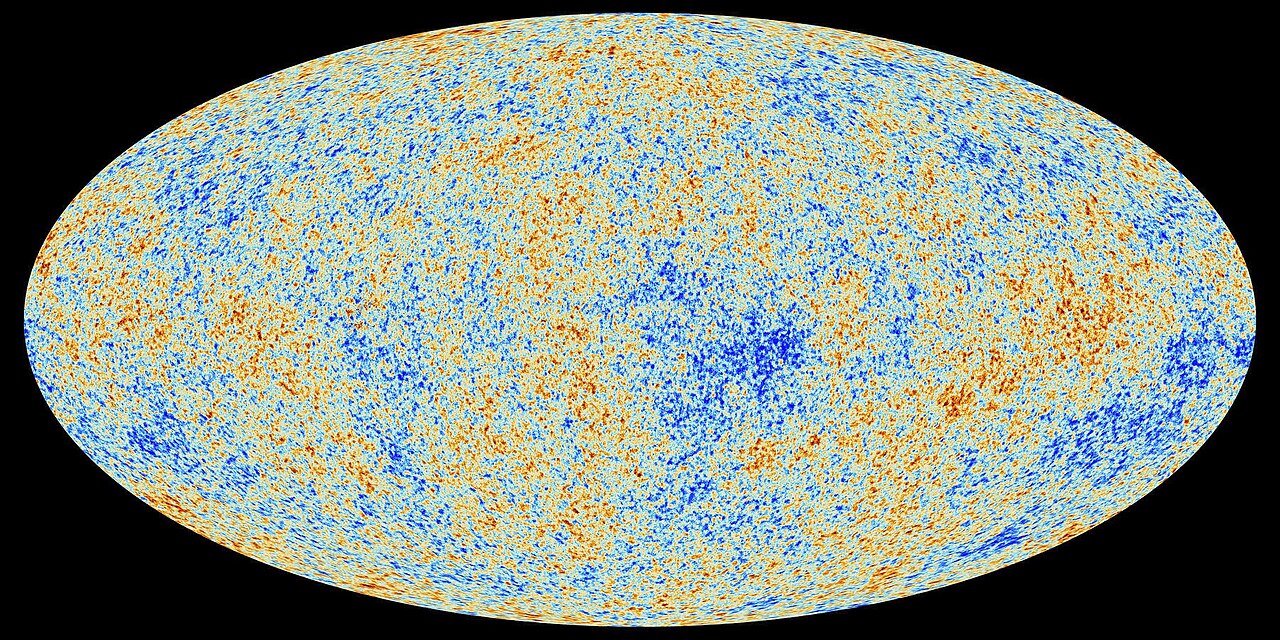
When the universe was about 380,000 years old, it cooled enough for atoms to form, and the hot, opaque plasma of the early universe became transparent. The light released at that moment — the glow of a universe at roughly 3,000 kelvin — has been travelling ever since. Thirteen point eight billion years of cosmic expansion have stretched its wavelength by a factor of about 1,100, from visible light into microwaves. Today it arrives from every direction as the cosmic microwave background, a glow at 2.725 kelvin above absolute zero.
In other words, the sky is not dark. It is blazing — in microwaves. The night sky looks black to us only because our eyes are tuned to a narrow slice of the spectrum, and the most ancient light in the universe has been stretched out of that slice. Point a microwave telescope at the darkest patch of sky and it glows, almost perfectly evenly, with the heat of the Big Bang itself. The Planck satellite mapped that glow across the whole sky in 2018, and the map is a baby photograph of the universe: the red and blue patches are temperature differences of a few millionths of a degree, the seeds from which galaxies grew.
That is the deepest form of the answer to Olbers. The paradox asked where all the light went. It never went anywhere. The light from the beginning is still arriving, in every direction, right now — we just had to build the right kind of eyes to see it.
Measuring the darkness from beyond Pluto
There is one more chapter, and it was written in the last few years. If the night sky is dark because most sightlines never meet a star, then the total visible light of the universe — the cosmic optical background, the sum of all the starlight ever emitted — should be a small, measurable number, roughly equal to the light of all the galaxies we can count. Measuring it is extraordinarily hard from anywhere near Earth, because sunlight scattered by dust in the inner solar system — the zodiacal light — drowns it out.
The New Horizons spacecraft, flying through the Kuiper Belt after its flyby of Pluto, is far enough from the Sun that the zodiacal light is effectively gone. Its LORRI camera, pointed at dark patches of sky 42 to 45 times further from the Sun than Earth, found a sky at least ten times darker than the darkest sky the Hubble Space Telescope can see. In 2021, Lauer and colleagues reported the first high-significance measurement: a cosmic optical background of 16.37 ± 1.47 nanowatts per square metre per steradian — roughly twice the light that deep galaxy counts could explain. A follow-up analysis in 2022 confirmed the excess at about four standard deviations. For a while it looked as though half the light in the universe came from sources nobody had counted: rogue stars stripped from galaxies, faint galaxies below Hubble’s detection limit, or something more exotic.
The story did not end there, and that is exactly what makes it good science. In 2024, Postman, Lauer and colleagues returned with a much larger survey — 16 fields plus 8 calibration fields — and a better handle on the remaining foreground: Milky Way starlight scattered by interstellar dust, estimated from far-infrared maps made by the Planck satellite. With that correction, the measured background fell to 11.16 ± 1.65 nanowatts per square metre per steradian, of which known galaxies account for 8.17 ± 1.18. The leftover, 2.99 ± 2.03, is formally classified as anomalous but is not significantly different from zero. The simplest interpretation, the authors wrote, is that the cosmic optical background is completely due to galaxies. The mystery light was, in the end, mostly dust in our own galaxy scattering starlight into the camera — a reminder that the hardest part of measuring the darkness is knowing what is glowing nearby.
The measured value is also worth pausing on for scale. All the visible light in the universe, gathered from every direction, amounts to a glow no brighter than a firefly a metre away. That is the quantitative answer to Olbers’ paradox: not zero, but astonishingly small — and now, finally, measured rather than assumed.
What the dark sky proves — and what it doesn’t
The darkness of the night is genuine evidence for a universe with a beginning. It is not the only evidence — the expansion of the universe, the abundance of light elements, and the microwave background all point the same way — but it is the oldest and the most democratic. Anyone who has looked up on a dark night has seen it.
It is worth being honest about the limits, too. The exact split between the two effects — finite age and expansion — is model-dependent; Harrison’s conclusion that age dominates holds within the standard Big Bang model, and the numbers would shift if the model did. The cosmic optical background is now measured, but its error bars still allow a small unexplained component, and future surveys may reopen the question. And the paradox, strictly speaking, only rules out a universe that is simultaneously infinite, eternal and static. A universe could be infinite in size and still have a dark sky, provided it had a beginning — which is exactly what modern cosmology says ours does.
That is the honest shape of the answer. The sky is dark because the universe is young — 13.8 billion years is not long enough for starlight to fill it. Expansion helps a little. And the light from the beginning never disappeared; it is still overhead, stretched into microwaves, waiting for instruments that can see it. If you want the short version first, the basics are in our Complete guide. This was the long version: four centuries, one failed fog, and a measurement made from beyond Pluto.
Frequently asked questions
What is Olbers’ paradox in simple terms?
If the universe were infinite, eternal and full of stars, every direction you looked would eventually end on a star, and the whole night sky would shine as brightly as the Sun’s surface. The sky is dark instead — so at least one of those assumptions must be wrong.
Why is the night sky dark if there are trillions of stars?
Because the universe is only about 13.8 billion years old. Light travels at a finite speed, so light from the most distant stars has not had time to reach us. A typical line of sight would need to travel on the order of 10²⁴ light-years to hit a star, but the observable universe is only about 93 billion light-years across.
Does the expansion of the universe cause the dark sky?
Only partly. Expansion redshifts distant starlight and dims it, but Edward Harrison showed it reduces the sky’s brightness by only a factor of a few. The finite age of the universe does almost all the work — even a non-expanding universe of the same age would have a dark night sky.
What is the cosmic microwave background, and what does it have to do with Olbers’ paradox?
It is the light released when the universe first became transparent, about 380,000 years after the Big Bang, stretched by expansion from visible light into microwaves at 2.725 kelvin. It is the answer to where the missing light went: the Big Bang’s glow is still arriving from every direction, just not in a form our eyes can see.
How dark is space, exactly?
NASA’s New Horizons spacecraft measured the cosmic optical background — all the visible starlight in the universe combined — at about 11 nanowatts per square metre per steradian in 2024. That is roughly the light of a firefly a metre away, and it matches the light of all known galaxies, with no large unexplained excess.
Who was Olbers, and did he discover the paradox?
Heinrich Wilhelm Olbers, a German astronomer, gave the clearest statement of the problem in 1823, which is why it bears his name. He was not the first: Thomas Digges raised it in 1576, Kepler in 1610, and Chéseaux calculated in 1744 that the sky should be 90,000 times brighter than sunlight. The first correct published solution — a universe of finite age — came from Johann Heinrich von Mädler in 1858.