What Are the Most Spoken Languages in the World?
There are more than 7,000 languages spoken in the world today — but just ten of them account for 5,561 million speaker-counts. English leads the ranking, yet Mandarin Chinese has far more native speakers. The difference comes down to how you count: total speakers means native speakers plus second-language speakers, and the two measures tell very different stories.
This article ranks the most spoken languages in the world by total speakers, using Ethnologue 2026, the standard reference for language speaker numbers. The counting rule is stated in full below, because it changes the ranking.
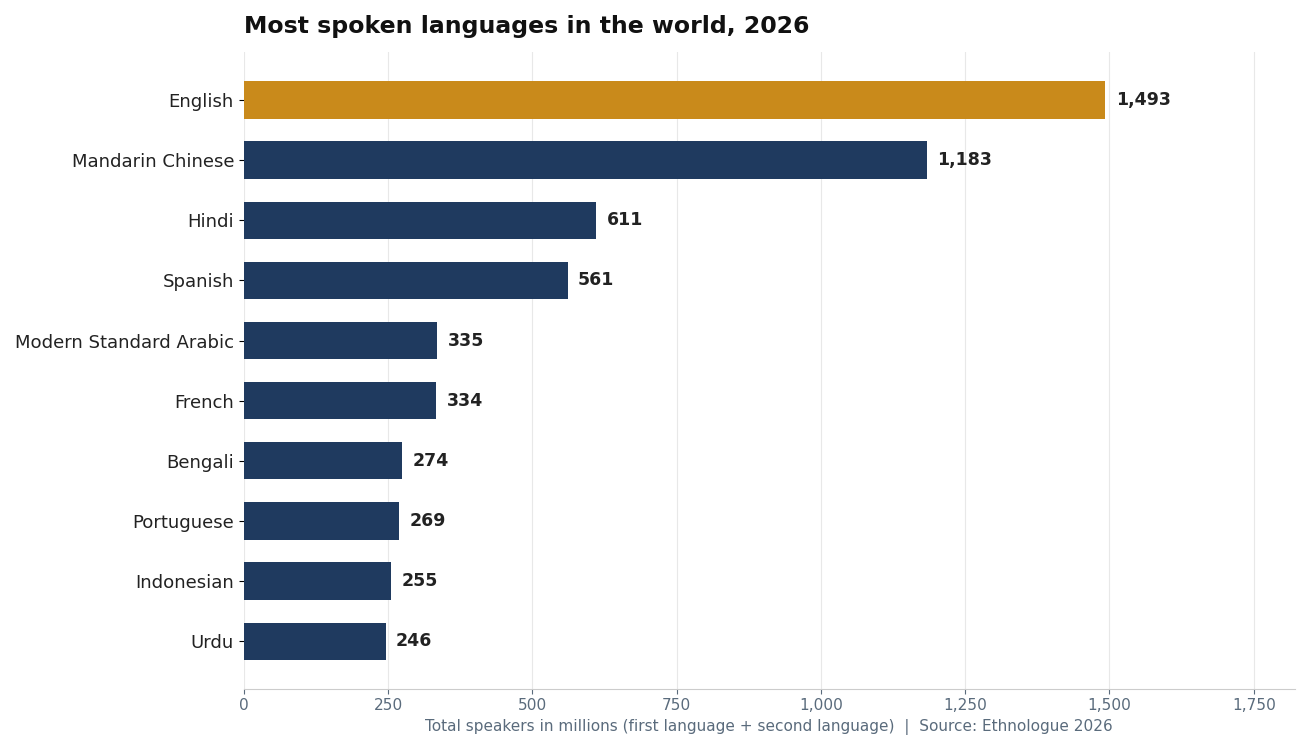
Most spoken languages in the world, 2026
| Rank | Language | Total speakers (millions) | Native speakers (L1) | Second-language speakers (L2) |
|---|---|---|---|---|
| 1 | English | 1,493 | 372 | 1,121 |
| 2 | Mandarin Chinese | 1,183 | 988 | 194 |
| 3 | Hindi | 611 | 347 | 264 |
| 4 | Spanish | 561 | 487 | 75 |
| 5 | Modern Standard Arabic | 335 | 0 | 335 |
| 6 | French | 334 | 75 | 258 |
| 7 | Bengali | 274 | 234 | 43 |
| 8 | Portuguese | 269 | 252 | 18 |
| 9 | Indonesian | 255 | 78 | 177 |
| 10 | Urdu | 246 | 78 | 168 |
Table: the ten most spoken languages by total speakers (L1 + L2), Ethnologue 2026. L1 and L2 figures are rounded independently, so their sum can differ from the total by a few million. Next in the ranking: Russian, 11th with 210 million speakers. Source: Ethnologue 2026, top-200 list, as reproduced in Wikipedia’s “List of languages by total number of speakers”.
English is first only because of second-language speakers
English has 1,493 million speakers — but only 372 million of them are native speakers. The other 1,121 million learned it as a second language, which is what puts English at the top. Mandarin Chinese, in second place with 1,183 million speakers, has 988 million native speakers — the most of any language in the world — and only 194 million second-language speakers.
Counted by native speakers alone, the ranking flips: Mandarin first (988 million), Spanish second (487 million), English third (372 million), Hindi fourth (347 million). Spanish is the striking case — 487 of its 561 million speakers are native, the second-highest native count in the world, with only 75 million second-language speakers.
French, Arabic and Indonesian are mostly second-language too
French looks like a mirror of English on a smaller scale: 334 million speakers in total, but only 75 million native — 258 million speak it as a second language, a legacy of its role in former French colonies and in international diplomacy. Indonesian is similar: 177 of its 255 million speakers are second-language speakers.
Modern Standard Arabic is the extreme case: 335 million speakers and zero native speakers. Nobody grows up speaking Modern Standard Arabic as a first language — people first learn their local dialect, and acquire the standard form through education. Hindi is counted here excluding Urdu, and Mandarin including Standard Chinese; the two are kept separate in this ranking, though their everyday spoken forms are almost completely mutually intelligible.
Urdu is the world’s tenth most spoken language
Urdu ranks tenth in the world with 246 million speakers — 78 million native and 168 million second-language speakers. It is one of only ten languages with more than 200 million speakers, and the only one in the top ten whose heartland spans two countries, Pakistan and India. Readers of our Urdu news site 101urdu.com are part of that 246 million.
Just outside the top ten, Russian is eleventh with 210 million speakers. The top ten together account for 5,561 million speaker-counts — but that is not 5,561 million people, because many people speak more than one of these languages and are counted twice.
Why rankings like this come with a warning
Rankings of languages should be used with caution, and the reason is simple: it is genuinely hard to say where one language ends and a dialect begins. Arabic is sometimes treated as one language centred on Modern Standard Arabic, and sometimes as many mutually unintelligible varieties. Chinese is sometimes one language because of a shared culture and written form, and sometimes several languages. Hindi and Urdu, meanwhile, are sometimes classified as a single language, Hindustani.
There is also no single standard for what counts as knowing a second language well enough to be counted. English, for example, has about 450 million native speakers by some counts but can be said to have as many as two billion speakers depending on the criterion used. Ethnologue 2026 is one consistent edition, used throughout this article — do not mix it with the 2025 edition’s roundups, which give different figures (English 1.53 billion, Mandarin 1.25 billion).
For a different kind of world ranking — emissions rather than speakers — see our companion chart: Which Country Emits the Most CO2? China leads with 12,289 million tonnes in 2024, nearly a third of the world total.
Frequently asked questions
What is the most spoken language in the world?
English, with 1,493 million total speakers according to Ethnologue 2026 — 372 million native speakers and 1,121 million second-language speakers. Mandarin Chinese is second with 1,183 million total speakers.
Which language has the most native speakers?
Mandarin Chinese, with 988 million native speakers — far ahead of Spanish (487 million) and English (372 million). Counted by native speakers only, Mandarin is first and English drops to third.
How many people speak Urdu?
246 million people speak Urdu — 78 million as a native language and 168 million as a second language — making it the tenth most spoken language in the world (Ethnologue 2026). Hindi is counted separately, excluding Urdu, with 611 million speakers.
Why does Modern Standard Arabic have zero native speakers?
Because nobody grows up speaking it as a first language. Arabic speakers first learn their local dialect — Egyptian, Levantine, Gulf and others — and acquire Modern Standard Arabic through formal education. Its 335 million speakers are all second-language speakers.
Sources
Ethnologue, 2026 edition, “What are the top 200 most spoken languages?”, as reproduced in Wikipedia’s List of languages by total number of speakers. All figures in this article are from that table; the chart was rebuilt by Informopedia from the published figures and is not a reproduction of any other graphic. Do not mix with Ethnologue 2025-edition roundups, which use different figures.