Antibiotic Resistance: Molecular Mechanisms & Evidence
Expert deep-dive into antibiotic resistance: β-lactamases, efflux pumps, target modification, HGT, critical appraisal of GRAM burden estimates, and frontier therapies.
1. Molecular Mechanisms of Resistance
Resistance phenotypes resolve, at the molecular level, into four canonical strategies — enzymatic drug modification, target alteration, reduced intracellular accumulation (efflux and permeability), and bypass pathways — frequently co-occurring within a single isolate. Multidrug-resistant (MDR) and extensively drug-resistant (XDR) phenotypes are typically the product of stacked mechanisms on mobile genetic elements rather than any single determinant.
1.1 β-Lactamases: the Ambler classification in clinical context
β-Lactamases hydrolyse the β-lactam ring shared by penicillins, cephalosporins, carbapenems, and monobactams. The Ambler molecular classification (classes A–D, based on amino-acid sequence homology) remains the working framework, cross-cut by the Bush–Jacoby–Medeiros functional scheme.
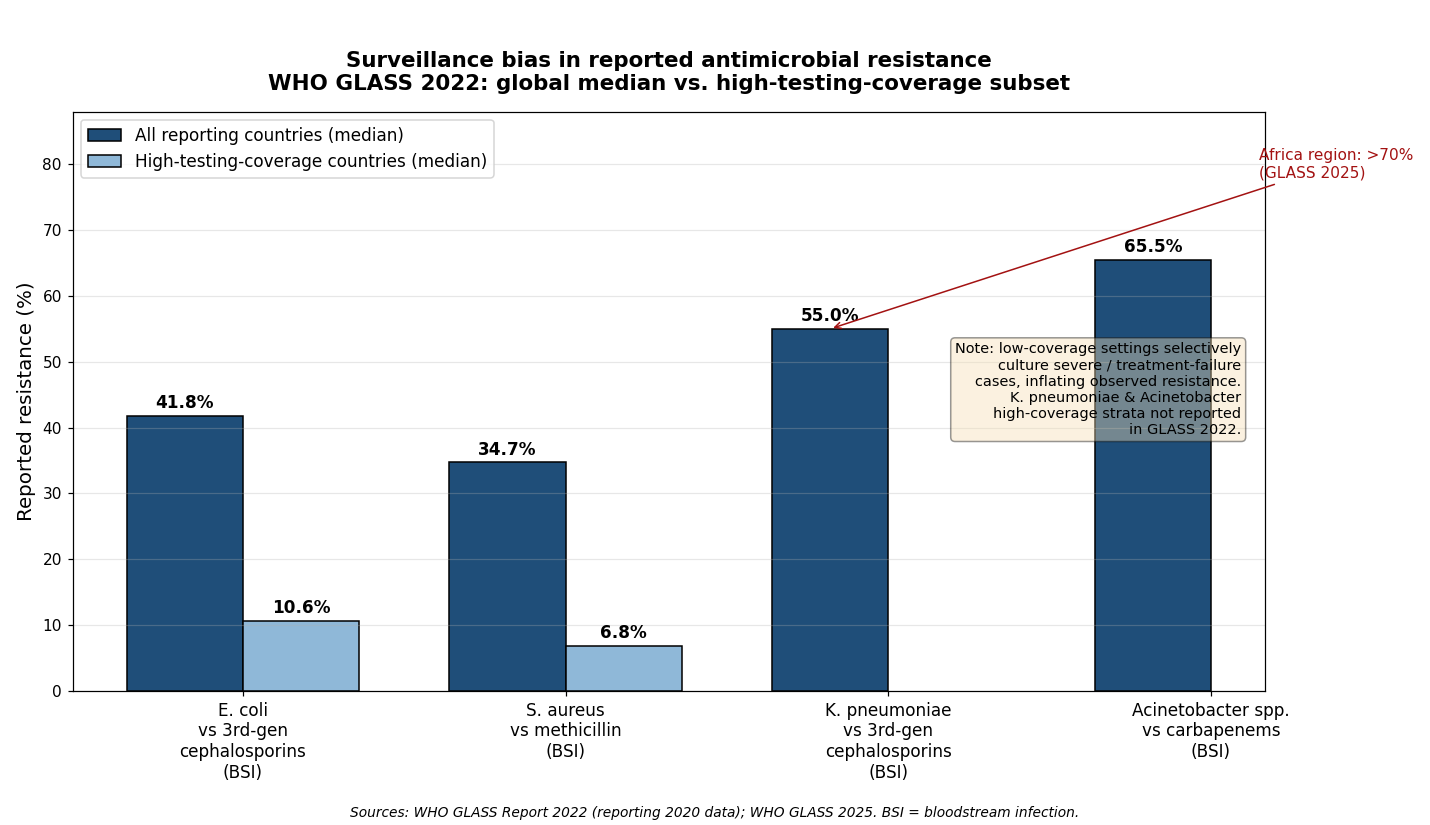
Class A (serine β-lactamases). Includes the classical TEM and SHV penicillinases and, critically, the extended-spectrum β-lactamases (ESBLs) — principally the CTX-M family (blaCTX-M), which has globally displaced TEM/SHV-derived ESBLs since the early 2000s. CTX-M-15, typically carried on IncF plasmids, is the dominant ESBL worldwide and the principal driver of third-generation cephalosporin resistance in Escherichia coli bloodstream isolates (global median 41.8% in WHO GLASS 2022 reporting). Class A also contains the Klebsiella pneumoniae carbapenemase (KPC) family — blaKPC-2 and blaKPC-3, mobilised by the Tn4401 transposon — endemic in the Americas, southern Europe, and parts of Asia, and the major carbapenemase of the high-risk K. pneumoniae clonal group 258 (ST258 and single-locus variants).
Class B (metallo-β-lactamases, MBLs). Zinc-dependent enzymes that hydrolyse all β-lactams except monobactams (aztreonam). The Verona integron-encoded MBL (VIM), imipenemase (IMP), and New Delhi MBL (NDM) families dominate clinically. blaNDM-1, first characterised by Yong et al. in a K. pneumoniae ST14 isolate from a patient returning from New Delhi (2009), resides on highly promiscuous plasmids (IncA/C, IncF, IncX3) and has since been detected in Enterobacterales, Acinetobacter spp., and Pseudomonas spp. across all continents [6]. MBLs are refractory to classical serine β-lactamase inhibitors (clavulanate, tazobactam, avibactam); therapeutic options centre on aztreonam-based combinations (aztreonam is stable to MBL hydrolysis but vulnerable to co-carried ESBLs/AmpC, hence aztreonam + avibactam or aztreonam + ceftazidime-avibactam strategies).
Class C (AmpC cephalosporinases). Chromosomally encoded and inducible in Enterobacter, Citrobacter, Serratia, and Pseudomonas (the “SPACE” organisms, classically ESCPM); plasmid-mediated variants (blaCMY, blaDHA, blaFOX) have disseminated into E. coli and Klebsiella. AmpC confers resistance to third-generation cephalosporins and cephamycins and is not inhibited by clavulanate; derepressed mutants emerge readily under cephalosporin therapy.
Class D (OXA-type enzymes). The OXA-48 family (blaOXA-48 and variants OXA-181, OXA-232) is the dominant carbapenemase in the Middle East, North Africa, and increasingly Europe, typically on IncL plasmids within Tn1999. OXA-48 hydrolyses carbapenems weakly but penicillins strongly; detection is challenging because meropenem MICs may remain in the susceptible range, and inhibitor-based phenotypic tests fail (OXA-48 is poorly inhibited by avibactam relative to class A enzymes, though ceftazidime-avibactam retains activity against OXA-48 producers lacking MBL co-carriage).
A clinically pivotal development is dual carbapenemase carriage — notably NDM + OXA-48 co-producers, now predominant in Romania, the Balkans, and South Asia — which defeats ceftazidime-avibactam (inactive against MBLs) and forces reliance on cefiderocol, aztreonam combinations, or polymyxins.
1.2 Target modification
Methicillin resistance in staphylococci. The mecA gene (and its homologue mecC, first described in 2011) encodes PBP2a, an alternative penicillin-binding protein with markedly reduced affinity for all β-lactams. Carried on the staphylococcal cassette chromosome mec (SCCmec), of which at least 13 types are recognised, mecA defines MRSA. SCCmec types I–III characterise hospital-associated lineages; types IV/V, smaller and more mobile, characterise community-associated MRSA.
Glycopeptide resistance in enterococci. The vanA and vanB operons reprogram peptidoglycan synthesis from D-alanyl-D-alanine to D-alanyl-D-lactate, reducing vancomycin binding affinity ~1,000-fold. vanA (on Tn1546) confers high-level resistance to vancomycin and teicoplanin; vanB confers variable vancomycin resistance with teicoplanin susceptibility retained.
Ribosomal methylation. erm genes (ermA, ermB, ermC) encode 23S rRNA methyltransferases conferring the MLSB phenotype — cross-resistance to macrolides, lincosamides, and streptogramin B. Inducible erm expression underlies the classic D-test-positive clindamycin resistance in S. aureus.
Fluoroquinolone resistance. Accumulates stepwise: chromosomal mutations in DNA gyrase (gyrA) and topoisomerase IV (parC/grlA) quinolone-resistance-determining regions (QRDRs), supplemented by plasmid-mediated quinolone resistance (PMQR) determinants — qnr genes (target protection), aac(6′)-Ib-cr (enzymatic modification), and efflux (QepA, OqxAB).
Colistin resistance. Historically chromosomal (mutations in mgrB, phoPQ, pmrAB two-component systems altering lipid A). The 2016 discovery of plasmid-mediated mcr-1, encoding a phosphoethanolamine transferase that modifies lipid A and reduces polymyxin binding, breached the last-resort barrier: colistin resistance became horizontally transmissible [7]. Ten mcr families (mcr-1 through mcr-10) are now described; notably, China’s 2017 ban on colistin as an animal growth promoter was followed by measurable declines in mcr-1 prevalence, a rare documented reversal [Shen et al., Lancet Microbe 2020].
1.3 Efflux pumps and permeability defects
RND-family efflux is the principal multidrug efflux architecture in Gram-negatives: AcrAB-TolC in Enterobacterales (substrates spanning β-lactams, fluoroquinolones, tetracyclines, chloramphenicol), MexAB-OprM and MexXY-OprM in P. aeruginosa (the latter upregulated by aminoglycoside exposure, conferring pan-aminoglycoside resistance), and AdeABC in A. baumannii. Overexpression typically arises from mutations in local repressors (acrR, mexR, adeRS). In Gram-positives, NorA (MFS family) mediates fluoroquinolone efflux in S. aureus.
Porin loss synergises with enzymatic mechanisms: loss or downregulation of OprD in P. aeruginosa confers carbapenem (particularly imipenem) resistance; loss of OmpK35/OmpK36 in K. pneumoniae elevates carbapenem MICs into the resistant range when combined with ESBL/AmpC production — a common genotype in KPC-negative carbapenem-resistant isolates.
1.4 Mechanistic stacking: why phenotypes exceed genotypes
Clinical resistance is rarely monogenic. A contemporary XDR K. pneumoniae ST147 isolate may simultaneously carry blaNDM-5 + blaOXA-181 (plasmid), blaCTX-M-15 (plasmid), rmtF (16S rRNA methylase → pan-aminoglycoside resistance), qnrS1, OmpK36 porin deficiency, and upregulated AcrAB-TolC. Treatment decisions therefore require genotype-informed phenotypic interpretation: the presence of an MBL gene contraindicates ceftazidime-avibactam monotherapy regardless of in-vitro susceptibility quirks, while KPC-only or OXA-48-only genotypes remain avibactam-susceptible. This is the rationale for rapid molecular diagnostics (e.g., multiplex PCR panels detecting blaKPC/blaNDM/blaVIM/blaIMP/blaOXA-48/*mcr-1) guiding therapy hours before phenotypic AST completes.
2. Horizontal Gene Transfer: the Mobilome
The Tier 1 guide introduced conjugation, transformation, and transduction. At expert depth, the operative unit is the mobilome — the totality of mobile genetic elements (MGEs) — and its nested architecture.
Plasmids. incompatibility (Inc) typing remains the epidemiological workhorse: IncF plasmids dominate ESBL and KPC carriage in Enterobacterales; IncX3 has driven the intercontinental spread of blaNDM; IncL/M carries blaOXA-48 within Tn1999; IncA/C plasmids host blaNDM alongside rmtC and qnrA. Broad-host-range plasmids (IncP, IncW) cross genus boundaries, explaining NDM detection in Vibrio, Aeromonas, and environmental isolates.
Transposons and insertion sequences. Tn4401 (flanking blaKPC with ISKpn7/ISKpn6) exemplifies a composite transposon mobilising a carbapenemase across plasmid backbones. ISEcp1 mobilises blaCTX-M from Kluyvera spp. chromosomes — the likely ancestral source of the CTX-M pandemic. IS26 mediates the assembly of complex multidrug-resistance regions through replicative transposition and homologous recombination.
Integrons. Class 1 integrons (intI1 integrase, attI recombination site, Pc promoter) capture gene cassettes (dfrA, aadA, blaVIM, blaIMP alleles) into arrays expressed from a single promoter. Complex class 1 integrons associated with ISCR1 elements mobilise adjacent resistance regions en bloc.
*The blaNDM-1 case study. Yong et al.’s 2009 characterisation [6] described a 180-kb transferable region in K. pneumoniae ST14 carrying blaNDM-1 alongside blaCMY-4, ereC, aadA1, and arr-2 — resistance to all β-lactams, aminoglycosides, macrolides, and rifampicin in a single transfer event. Kumarasamy et al. (2010) then documented community and hospital dissemination across India, Pakistan, and the UK, including in patients with no hospital contact — establishing NDM as an endemic community-associated carbapenemase, a epidemiological pattern distinct from the healthcare-confined KPC epidemic [8]. The subsequent detection of blaNDM in New Delhi drinking water and seepage samples (Walsh et al., Lancet Infect Dis* 2011) demonstrated environmental reservoirs sustaining transmission independent of clinical antibiotic pressure.
3. Critical Appraisal of the Key Burden Studies
3.1 GRAM 2022 (The Lancet 2022;399:629–655) [1]
Design. Systematic analysis estimating deaths and disability-adjusted life-years (DALYs) attributable to and associated with bacterial AMR across 204 countries in 2019, covering 23 pathogens and 88 pathogen–drug combinations.
Data sources. 471 million individual records: surveillance networks, hospital microbiology data, published literature, and vital registration. Statistical framework: mixed-effects models with spatiotemporal Gaussian process regression (ST-GPR) for prevalence of resistance; counterfactual estimation comparing observed outcomes against a scenario in which resistant infections were replaced by susceptible ones (attributable) or by no infection (associated).
Strengths. First globally comprehensive counterfactual burden estimate; transparent distinction between attributable and associated mortality; pathogen–drug granularity enabling targeted policy.
Limitations (GRADE: moderate).
- Data sparsity: high-quality microbiology data covered a minority of the global population; estimates for sub-Saharan Africa and parts of Asia rest heavily on modelled extrapolation from covariates (healthcare access, antibiotic consumption proxies) rather than observed isolates.
- Counterfactual assumptions: the “susceptible replacement” counterfactual assumes resistant and susceptible infections are otherwise prognostically equivalent — contested, since resistant infections concentrate in sicker, hospitalised patients (confounding by indication).
- Syndrome coverage: restricted to lower respiratory, bloodstream, intra-abdominal, urinary, and selected other syndromes; community burden of resistant UTIs and SSTIs is under-captured.
- Temporal stasis: a single-year (2019) snapshot; cannot distinguish secular trends from surveillance artefacts.
3.2 GRAM 2024 — forecasts to 2050 (The Lancet 2024;404:1199–1226) [2]
Design. Extension of the GRAM framework to 1990–2021 (520 million records) with forecasts to 2050 under reference, better-care, and Gram-negative-drug scenarios, using forecasted covariates (demographics, healthcare access, antibiotic consumption).
Strengths. Longitudinal structure permits trend inference (e.g., the under-five mortality halving vs. over-70 doubling); scenario modelling quantifies intervention value (92 million avertable deaths).
Limitations (GRADE: low–moderate for forecasts, moderate for historical estimates).
- Forecast uncertainty compounds: 2050 projections extrapolate resistance trajectories, demographic shifts, and healthcare development simultaneously; the published uncertainty intervals (not always foregrounded in secondary reporting) are wide.
- Intervention scenarios are stylised: the “better care” scenario assumes uniform improvements in infection prevention and antibiotic access that are aspirational rather than policy-specified.
- Surveillance bias over time: apparent trends partly reflect expanding surveillance coverage (GLASS grew from 25 to 104 countries, 2016–2023); the models adjust for this, but residual confounding is likely.
- Pathogen scope unchanged: fungal, mycobacterial, and viral resistance excluded — the “AMR burden” is strictly bacterial.
3.3 WHO Bacterial Priority Pathogens List, 2024 [5]
Design. Not a primary study but a structured expert prioritisation: multi-criteria decision analysis (MCDA) scoring 24 pathogens across criteria including attributable mortality, incidence, 10-year resistance trends, transmissibility, preventability, treatability, and pipeline status, informed by systematic reviews and Delphi-like expert consultation.
Strengths. Transparent criteria; directly actionable for R&D funders; the 2024 revision’s elevation of third-generation-cephalosporin-resistant Enterobacterales and carbapenem-resistant A. baumannii to “critical” reflects surveillance reality.
Limitations (GRADE: n/a — consensus product).
- Expert judgement dependence: criterion weights reflect expert values, not empirical derivation; alternative weightings would reorder the list.
- Regional blindness: a single global ranking obscures regional priorities (e.g., drug-resistant Salmonella Typhi ranks higher in South Asia than globally).
- Pipeline criterion circularity: pathogens score higher partly because the pipeline is empty — which is itself a market-failure artefact, not a biological property.
4. Statistical Deep-Dive: Reading Burden Estimates Critically
4.1 Attributable vs. associated: the estimand matters
The GRAM headline figures — 1.27 million attributable vs. 4.95 million associated deaths (2019) — answer different questions. “Attributable” estimates deaths that would not have occurred had the infection been drug-susceptible (the causal estimand relevant to intervention evaluation). “Associated” counts deaths in which a resistant infection was present, regardless of causality. Media and policy discourse frequently conflate the two; the nearly four-fold gap between them is itself a measure of the underlying confounding.
4.2 Uncertainty intervals and what drives them
GRAM 2022 reported 1.27 million attributable deaths with a 95% uncertainty interval of 0.91–1.71 million — a ±35% span reflecting data sparsity and model uncertainty. Uncertainty is geographically structured: estimates for Western Europe (dense surveillance) carry narrow intervals; sub-Saharan Africa (sparse data, high modelled fraction) carries the widest. A responsible reading treats the point estimate as the centre of a distribution, not a census count.
4.3 Surveillance bias: the GLASS paradox
WHO GLASS 2022 data illustrate a fundamental surveillance artefact: the median third-generation-cephalosporin resistance in E. coli bloodstream isolates was 41.8% across all reporting countries but 10.6% in high-testing-coverage countries; MRSA showed 34.7% vs. 6.8% respectively (see Chart A). Low-coverage settings selectively culture severe, treatment-failure cases, inflating observed resistance. Models attempt covariate adjustment, but the direction of residual bias is almost certainly upward in data-poor regions — precisely where the burden is estimated to be highest. This does not invalidate the estimates, but it widens their credible intervals asymmetrically.
4.4 Heterogeneity: the burden is not one epidemic
GRAM 2024’s super-regional disaggregation shows the AMR crisis is several distinct epidemics: South Asia and sub-Saharan Africa dominate absolute mortality; high-income regions show lower rates but rising carbapenem-resistance incidence (EU/EEA CRKP bloodstream incidence +57.5% from 2019 to 2023, ECDC EARS-Net). Age-structure effects are profound — paediatric AMR mortality halved since 1990 while over-70 mortality more than doubled — meaning crude global trends mask opposing age-specific trajectories. Any thesis using these estimates must stratify; unstratified global figures are policy shorthand, not analytical endpoints.
5. Literature Table: Landmark Studies
| # | Study | Year | Journal | Design | Population / scope | Key finding | Limitation |
|---|---|---|---|---|---|---|---|
| 1 | Antimicrobial Resistance Collaborators (GRAM) | 2022 | Lancet | Systematic analysis, counterfactual modelling | 204 countries, 471M records, 23 pathogens | 1.27M deaths attributable to bacterial AMR in 2019 (95% UI 0.91–1.71M) | Heavy modelled extrapolation in data-poor regions; single-year snapshot |
| 2 | GBD 2021 AMR Collaborators (GRAM) | 2024 | Lancet | Systematic analysis + forecasts to 2050 | 1990–2021, 520M records | 1.14M deaths in 2021; 1.91M/yr projected by 2050; 39M cumulative 2025–2050; 92M avertable via better care | Compound forecast uncertainty; stylised intervention scenarios |
| 3 | Yong et al. | 2009 | Antimicrob Agents Chemother | Molecular characterisation | Single K. pneumoniae ST14 isolate + E. coli co-isolate | First description of blaNDM-1 on a 180-kb transferable element; 32.4% identity to VIM-1/2 | Single isolate; clinical significance not yet established at publication |
| 4 | Kumarasamy et al. | 2010 | Lancet Infect Dis | Multicentre surveillance | India, Pakistan, UK | Community dissemination of NDM-1 producers, including patients without hospital exposure | Convenience sampling; prevalence estimates not population-based |
| 5 | Liu et al. | 2016 | Lancet Infect Dis | Microbiological + molecular epidemiology | Animals and humans, China | First plasmid-mediated colistin resistance (mcr-1), phosphoethanolamine transferase | Initial prevalence estimates from non-random sampling |
| 6 | Xu et al. | 2017 | Ann Clin Microbiol Antimicrob | Systematic review + meta-analysis | 2,462 CRKP patients, literature to Dec 2015 | Pooled mortality 42.14% CRKP vs 21.16% CSKP; 54.30% in BSI | Unadjusted pooling; confounding by illness severity; pre-2016 literature |
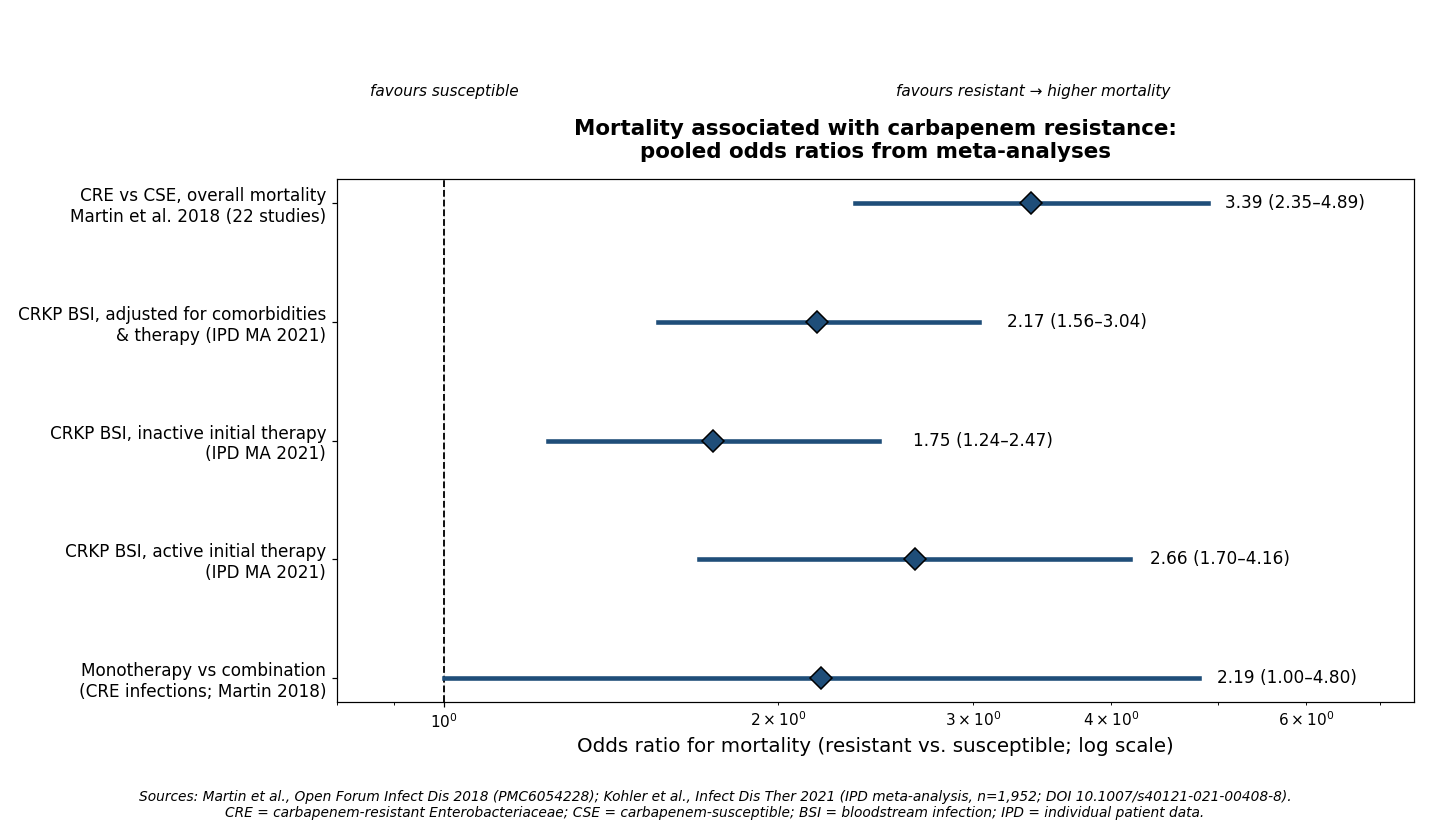
| 7 | Martin et al. | 2018 | Open Forum Infect Dis | Systematic review + meta-analysis (22 studies) | Hospitalised adults, CRE vs CSE serious infections | Mortality OR 3.39 (95% CI 2.35–4.89) for CRE vs CSE; monotherapy OR 2.19 (1.00–4.80) vs combination | Heterogeneous infection sites; observational data only |
| 8 | Jault et al. (PhagoBurn) | 2019 | Lancet Infect Dis | Randomised, double-blind phase 1/2 trial | 27 patients, P. aeruginosa burn-wound infection | Phage cocktail inferior to standard care (HR 0.29, 95% CI 0.10–0.79); titre loss 10⁶→10² PFU/mL during storage | Under-recruited; manufacturing failure confounds biological inference |
| 9 | Kohler et al. (IPD meta-analysis) | 2021 | Infect Dis Ther | Two-stage individual-patient-data meta-analysis, 14 studies | 1,952 patients, CRKP vs CSKP bloodstream infection | Adjusted OR 2.17 (95% CI 1.56–3.04), I²=44.1%; effect persists with active therapy | IPD obtained from 14/28 eligible studies (selection risk); colistin-era therapies |
| 10 | Walker et al. | 2026 | Lancet Infect Dis | Retrospective cohort | 5,065 difficult-to-treat Gram-negative infections, 471 US hospitals, 2016–2023 | Next-generation antibiotic use +300% with no mortality reduction; >75% initial discordant therapy | Observational; residual confounding; US-only |
| 11 | Breen et al. | 2026 | Lancet Microbe | Dynamic in-vitro infection model | XDR P. aeruginosa ST235 | Dual β-lactam (ceftolozane-tazobactam + meropenem) bactericidal and suppresses resistance emergence | Preclinical; no clinical outcomes |
| 12 | WHO | 2024 | WHO publication | MCDA expert prioritisation | 24 pathogens, global | CRAB and 3GC-R Enterobacterales “critical”; CRKP top-ranked overall | Expert-weight dependence; single global ranking masks regional priorities |
6. The Therapeutic Frontier
6.1 Bacteriophage therapy: from compassionate use to randomised trials
Phage therapy’s evidence base remains predominantly observational — case series and compassionate-use cohorts (notably the Belgian and Georgian programs) report favourable outcomes but are uncontrolled and subject to selection bias. The randomised evidence is sobering:
PhagoBurn (Jault et al., 2019) [11] — the first substantial European RCT (phage cocktail PP1131 vs. silver sulfadiazine for P. aeruginosa burn-wound infection, n=27) — found phage inferior to standard care for the primary endpoint (time to sustained bacterial-burden reduction: median 144h vs 47h; HR 0.29, 95% CI 0.10–0.79, p=0.018). The critical post-hoc finding: cocktail titre had decayed from 10⁶ to 10² PFU/mL during storage — a pharmaceutical failure, not a biological one. The trial’s legacy is regulatory as much as scientific: it exposed the absence of GMP manufacturing standards for phage products.
*LBP-EC01 / ELIMINATE (Kim et al., Lancet Infect Dis 2024) — a CRISPR-Cas3-enhanced six-phage cocktail against E. coli* UTI — represents the next generation: engineered phages with defined pharmacokinetics. Phase 2 part 1 (open-label) showed tolerability and rapid bacterial reduction; the blinded controlled part is underway. Trial phase: Phase 2.
The field’s trajectory is toward defined phage products (fixed cocktails, engineered phages, endolysins) rather than personalised magistral preparations — the only path compatible with conventional regulatory frameworks.
6.2 Dual β-lactam and precision combination therapy
Breen et al. (2026) [4] demonstrated in a dynamic hollow-fibre infection model that ceftolozane-tazobactam + meropenem achieves bactericidal killing of XDR P. aeruginosa ST235 while suppressing resistance amplification — exploiting complementary PBP affinities. The mechanistic rationale generalises: dual β-lactams with non-overlapping PBP targets and differential β-lactamase stability can be synergistic. Clinical translation requires RCTs; current status is preclinical, but the paradigm — genotype-guided combination design rather than empiric escalation — is the near-term frontier.
6.3 Antimicrobial peptides and next-generation polymyxins
Colistin (polymyxin E) remains the archetypal AMP in clinical use, limited by nephrotoxicity and neurotoxicity. Development focuses on polymyxin analogues with improved therapeutic indices and novel AMP classes (defensin mimetics, brilacidin). No AMP has yet achieved regulatory approval for systemic MDR Gram-negative infection; the class remains preclinical to Phase 1 for novel agents.
6.4 CRISPR-based antimicrobials
Sequence-specific antimicrobials using CRISPR-Cas systems (Bikard et al., Nat Biotechnol 2014, DOI: 10.1038/nbt.3043) enable targeted killing of strains carrying specific resistance genes or virulence factors, delivered via phagemids or conjugative plasmids — conceptually, antimicrobials that discriminate at the sequence level, sparing the commensal microbiome. Locus Biosciences’ CRISPR-Cas3-enhanced phage platform (LBP-EC01, above) is the clinical vanguard. SNIPR Biome and Eligo Bioscience pursue engineered-phage CRISPR delivery. Status: Phase 1–2; key unresolved issues include delivery efficiency in vivo, anti-CRISPR counter-resistance, and regulatory classification.
7. Open Research Questions
- What is the true community burden of carbapenemase carriage? Hospital-based surveillance systematically misses community reservoirs. The NDM drinking-water findings suggest environmental–community–clinical transmission loops that no current surveillance system quantifies. A thesis-grade project: longitudinal community carriage cohorts with whole-genome sequencing in a high-prevalence setting, estimating the community attributable fraction of clinical CRKP infections.
- Can resistance be reversed at population scale, and on what timescale? China’s colistin-ban natural experiment (declining mcr-1 after the 2017 agricultural ban) is the cleanest available evidence, but fitness-cost dynamics, compensatory mutations, and co-selection (resistance genes hitchhiking with selected determinants on the same plasmid) complicate generalisation. Open: formal causal-inference analyses of stewardship interventions with genomic endpoints.
- What drives the discordance between in-vitro susceptibility and clinical outcome in CRKP bacteraemia? The IPD meta-analysis finding — excess mortality persisting even with active therapy (aOR 2.21) — implicates virulence–resistance linkage, delayed effective therapy, or pharmacokinetic failure rather than resistance per se. Disentangling these requires prospective cohorts with timed therapy data and virulence genotyping.
- How do we regulate and manufacture defined phage products? The PhagoBurn titre failure was a manufacturing problem with clinical consequences. Open questions span formulation science (stability, GMP), trial design (personalised vs. fixed cocktails, appropriate endpoints given phage pharmacodynamics), and regulatory pathways (biological vs. magistral frameworks across jurisdictions).
- What is the evolutionary risk of CRISPR-based antimicrobials? Sequence-specific killing imposes strong selection for target-site mutation and anti-CRISPR (acr) gene acquisition — themselves mobilisable. The field lacks systematic assessments of resistance emergence rates to CRISPR antimicrobials comparable to those available for small molecules. A combined experimental-evolution and modelling thesis could define the durability envelope before clinical deployment scales.
References
- Antimicrobial Resistance Collaborators. Global burden of bacterial antimicrobial resistance in 2019: a systematic analysis. Lancet. 2022;399(10325):629–655. https://doi.org/10.1016/S0140-6736(21)02724-0
- GBD 2021 Antimicrobial Resistance Collaborators. Global burden of bacterial antimicrobial resistance 1990–2021: a systematic analysis with forecasts to 2050. Lancet. 2024;404(10459):1199–1226. https://doi.org/10.1016/S0140-6736(24)01867-1
- Walker MK et al. Survival trends in patients with difficult-to-treat, antibiotic-resistant, Gram-negative infections in the era of next-generation antibiotics in the USA: a retrospective cohort study. Lancet Infect Dis. 2026;26(7):659–670. https://doi.org/10.1016/S1473-3099(26)00020-4
- Breen SKJ et al. Dual β-lactam therapy against high-risk Pseudomonas aeruginosa isolates: a dynamic in-vitro infection model study. Lancet Microbe. 2026. https://doi.org/10.1016/j.lanmic.2026.101364
- World Health Organization. WHO bacterial priority pathogens list, 2024: bacterial pathogens of public health importance to guide research, development and strategies to prevent and control antimicrobial resistance. Geneva: WHO; 2024. https://www.who.int/publications/i/item/9789240093461
- Yong D, Toleman MA, Giske CG, Cho HS, Sundman K, Lee K, Walsh TR. Characterization of a new metallo-β-lactamase gene, bla(NDM-1), and a novel erythromycin esterase gene carried on a unique genetic structure in Klebsiella pneumoniae sequence type 14 from India. Antimicrob Agents Chemother. 2009;53(12):5046–5054. https://doi.org/10.1128/AAC.00774-09 (open archive: https://pmc.ncbi.nlm.nih.gov/articles/PMC2786356/)
- Liu YY, Wang Y, Walsh TR, Yi LX, Zhang R, Spencer J, Doi Y, Tian G, Dong B, Huang X, Yu LF, Gu D, Ren H, Chen X, Lv L, He D, Zhou H, Liang Z, Liu JH, Shen J. Emergence of plasmid-mediated colistin resistance mechanism MCR-1 in animals and human beings. Lancet Infect Dis. 2016;16(2):161–168. https://doi.org/10.1016/S1473-3099(15)00424-7
- Kumarasamy KK, Toleman MA, Walsh TR, Bagaria J, Butt F, Balakrishnan R, et al. Emergence of a new antibiotic resistance mechanism in India, Pakistan, and the UK: a molecular, biological, and epidemiological study. Lancet Infect Dis. 2010;10(9):660–671. https://doi.org/10.1016/S1473-3099(10)70143-2
- Xu L, Sun X, Ma X. Systematic review and meta-analysis of mortality of patients infected with carbapenem-resistant Klebsiella pneumoniae. Ann Clin Microbiol Antimicrob. 2017;16:18. https://doi.org/10.1186/s12941-017-0191-3
- Martin SJ et al. Association between carbapenem resistance and mortality among adult, hospitalized patients with serious infections due to Enterobacteriaceae: systematic literature review and meta-analysis. Open Forum Infect Dis. 2018. https://pmc.ncbi.nlm.nih.gov/articles/PMC6054228/
- Jault P, Leclerc T, Jennes S, Pirnay JP, Que YA, Resch G, et al. Efficacy and tolerability of a cocktail of bacteriophages to treat burn wounds infected by Pseudomonas aeruginosa (PhagoBurn): a randomised, controlled, double-blind phase 1/2 trial. Lancet Infect Dis. 2019;19(1):35–45. https://doi.org/10.1016/S1473-3099(18)30482-1
- Kohler PP et al. The impact of carbapenem resistance on mortality in patients with Klebsiella pneumoniae bloodstream infection: an individual patient data meta-analysis of 1952 patients. Infect Dis Ther. 2021. https://doi.org/10.1007/s40121-021-00408-8
- Stewardson AJ, Marimuthu K, Sengupta S, et al. Effect of carbapenem resistance on outcomes of bloodstream infection caused by Enterobacteriaceae in low-income and middle-income countries (PANORAMA): a multinational prospective cohort study. Lancet Infect Dis. 2019;19(6):601–610. https://doi.org/10.1016/S1473-3099(18)30792-8
- Bikard D, Euler CW, Jiang W, Nussenzweig PM, Goldberg GW, Duportet X, Fischetti VA, Marraffini LA. Exploiting CRISPR-Cas nucleases to produce sequence-specific antimicrobials. Nat Biotechnol. 2014;32:1146–1150. https://doi.org/10.1038/nbt.3043
- World Health Organization. Global antimicrobial resistance and use surveillance system (GLASS) report 2022. Geneva: WHO; 2022. https://www.who.int/publications/i/item/9789240062702
- European Centre for Disease Prevention and Control. Antimicrobial resistance surveillance in Europe 2023 — 2021 data (EARS-Net). Stockholm: ECDC; 2023. https://www.ecdc.europa.eu/en/publications-data/antimicrobial-resistance-surveillance-europe-2023
- US Centers for Disease Control and Prevention. Antibiotic Resistance Threats in the United States, 2019. Atlanta: CDC; 2019. https://www.cdc.gov/antimicrobial-resistance/data-research/threats/
Charts produced from WHO GLASS 2022, WHO GLASS 2025, ECDC EARS-Net 2023, and the meta-analyses cited above. Draft for review — not published. Last updated: October 2026.