Which Country Has Won the Most Nobel Prizes?
Since 1901, the Nobel Prizes have been awarded 577 times to 889 recipients — 860 individuals and 22 organisations. But the prizes have not been shared evenly around the world. One country has won nearly three times as many as its closest rival.
This article ranks the countries with the most Nobel laureates, using the country list published by the Nobel Prize committee on nobelprize.org, including the 2026 laureates. The counting method matters a great deal here, so it is explained in full below.
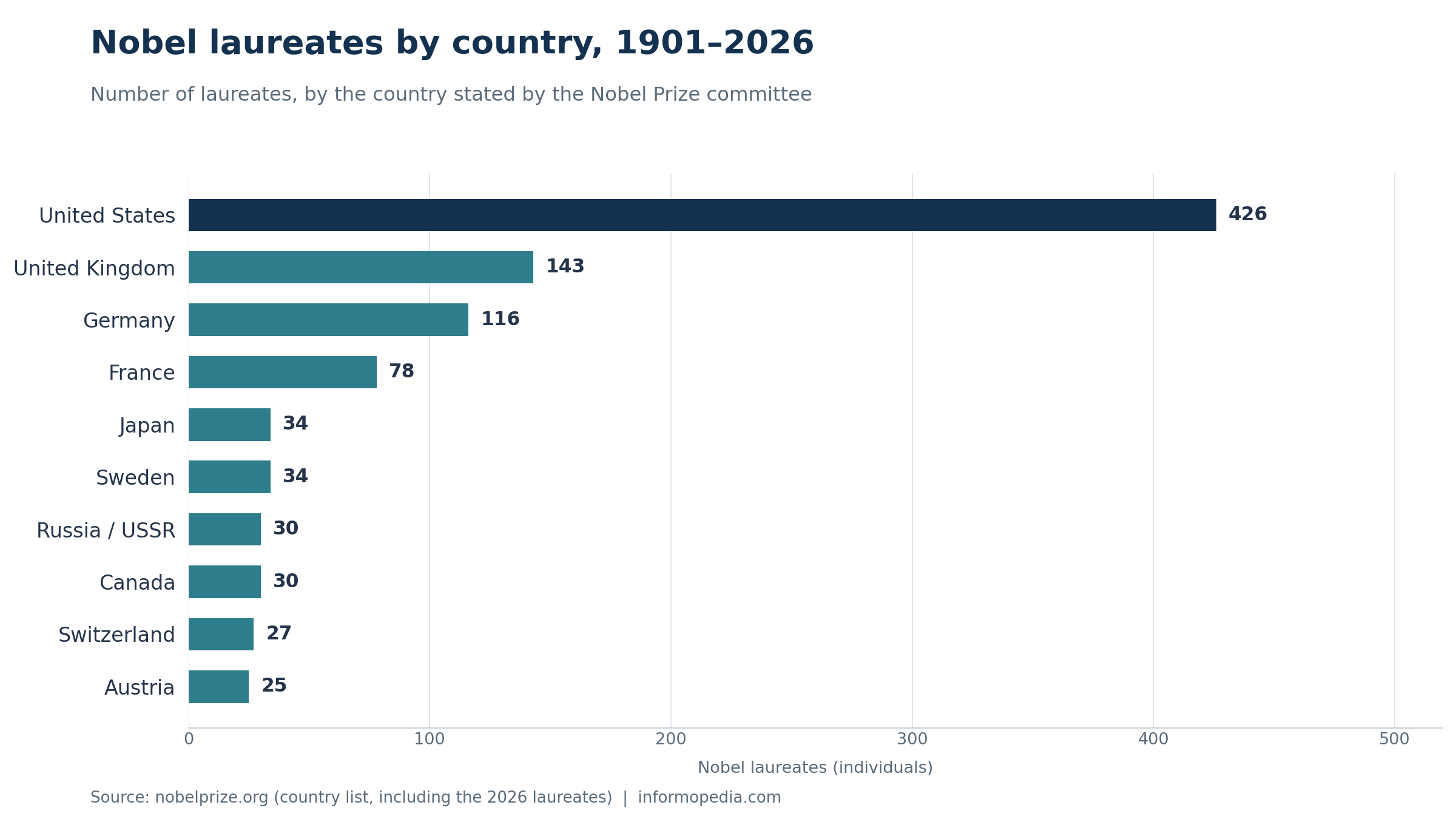
Nobel laureates by country, 1901–2026
| Rank | Country | Nobel laureates | Nobel Prizes* |
|---|---|---|---|
| 1 | United States | 426 | 429 |
| 2 | United Kingdom | 143 | 144 |
| 3 | Germany | 116 | 116 |
| 4 | France | 78 | 79 |
| 5 | Japan | 34 | 34 |
| 5 | Sweden | 34 | 34 |
| 7 | Russia / USSR | 30 | 30 |
| 7 | Canada | 30 | 30 |
| 9 | Switzerland | 27 | 27 |
| 10 | Austria | 25 | 25 |
*The “Nobel Prizes” column counts prizes rather than people: it is higher than the laureate count where a person won more than once. The United States’ 429 prizes against 426 laureates reflect three double winners — John Bardeen, Linus Pauling and Frederick Sanger. Next in the ranking: Netherlands 22, Italy 21, Poland 19 (20 prizes), Hungary 16, Australia 15. Source: nobelprize.org country list, via the Nobel committee’s stated countries.
The United States leads by almost three to one
The United States has produced 426 Nobel laureates — nearly three times the United Kingdom’s 143, and more than the next three countries (the UK, Germany and France) combined. American laureates span all six prize categories, with particular strength in Medicine and Physics, and the 2026 season added four more Americans, including the Medicine laureate Karl Deisseroth and the Physics laureate Francis Halzen.
The United Kingdom is a clear second with 143 laureates, followed by Germany with 116 and France with 78. Added together, the top four countries’ counts come to 763 — though a few laureates are listed under two countries, so the number of individual people is slightly lower.
How the counting works — and why other lists differ
Different sources give slightly different totals for the same countries, and the reason is method, not error. This article counts laureates, not prizes: a shared prize counts once per laureate, and a person who won twice still counts once in the laureate column (the prizes column shows the difference). Countries are those stated by the Nobel Prize committee on nobelprize.org — generally the country of affiliation at the time of the award — not the laureate’s country of birth.
That last distinction matters. Counted by birthplace instead, the United States’ total falls by well over a hundred, because many American laureates were born elsewhere and moved to the US to work. And because the committee sometimes names more than one country for a laureate, some people appear under two countries — so the country figures overlap and do not add up to the global total of 889 recipients. Any ranking that mixes these methods will disagree with this one.
The rest of the top ten
After the top four, the numbers drop sharply. Japan and Sweden are tied on 34 laureates each — Sweden’s total is remarkable for a country of its size, and per head of population the small European countries, Sweden and Switzerland among them, come out well ahead of the United States. Russia and the Soviet Union together count 30, level with Canada on 30, while Switzerland has 27 and Austria 25.
Further down the list, the Netherlands has 22 laureates, Italy 21 and Poland 19. India has 13. Pakistan has two Nobel laureates: the physicist Abdus Salam, who won the Physics Prize in 1979, and Malala Yousafzai, who won the Peace Prize in 2014.
The China paradox: first in patents, 3 Nobel laureates
China presents the sharpest contrast in this ranking. In our companion chart, China filed 1,910,431 patent applications in 2025 — 48.4% of the world total, more than any other country by a wide margin. Yet China has only three Nobel laureates: Liu Xiaobo (Peace, 2010), Mo Yan (Literature, 2012) and Tu Youyou (Medicine, 2015).
The two measures are not really comparable. Patent counts record one year of filing volume, mostly domestic, in a system China has built up over the last two decades. Nobel counts record 125 years of peer-recognised breakthroughs, judged by committees in Stockholm and Oslo. China dominates the first because it files an enormous number of applications at home; it barely registers in the second because its modern research system is young, and because a Nobel Prize typically recognises work done decades earlier. The gap is a reminder that filing the most patents and winning the most Nobels measure very different things — volume today versus recognised breakthroughs over a century.
Frequently asked questions
Which country has won the most Nobel Prizes?
The United States, with 426 Nobel laureates and 429 Nobel Prizes (the difference is three Americans who won twice). The United Kingdom is second with 143 laureates, followed by Germany with 116 and France with 78.
How many Nobel Prizes have been awarded in total?
The Nobel Prizes and the Prize in Economic Sciences have been awarded 577 times to 889 recipients since 1901 — 860 individuals and 22 organisations. Twenty-six of the awards, all Peace Prizes, went to organisations rather than people.
Why do different lists give different totals for the same country?
Because the counting method differs. This article counts laureates by the country stated by the Nobel committee. Other lists count prizes instead of people, count by birthplace instead of affiliation, or count a laureate under every country named for them. By birthplace, for example, the United States’ total is far lower than 426, because many American laureates were born abroad.
How many Nobel laureates does Pakistan have?
Two: Abdus Salam, who won the Nobel Prize in Physics in 1979, and Malala Yousafzai, who won the Nobel Peace Prize in 2014.
Sources
NobelPrize.org, list of Nobel laureates by country (including the 2026 laureates): nobelprize.org. All figures in this article are from that list; the chart was rebuilt by Informopedia from the published figures and is not a reproduction of any other graphic.