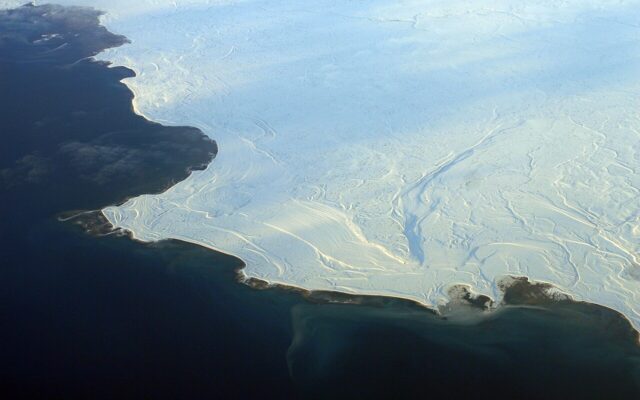
Why Is the Greenland Ice Sheet Melting So Fast? A Complete Guide
Greenland is losing ice at a pace that would have sounded absurd a generation ago. Between 2002 and 2025, the island’s great ice sheet shed about 264 billion tonnes of ice a year, according to NASA’s GRACE satellites — enough meltwater to fill more than 100 million Olympic swimming pools annually. That loss is now adding about 0.8 millimetres a year to global sea levels, and the rate is still climbing.
This is not a story about a single hot summer. Greenland’s ice loss has accelerated for three decades, driven by warmer air, warmer oceans and feedbacks that make each year’s melt easier than the last. This guide explains how the ice sheet works, why it is melting so fast, what the evidence shows, and what it means for sea levels — including the parts of the story that are already locked in, whatever happens next.
How big is the Greenland ice sheet?
The Greenland ice sheet covers about 1.7 million square kilometres — roughly 80 percent of the island, an area about three times the size of Texas. In places it is nearly 3 kilometres thick. All told it holds about 2.9 million cubic kilometres of ice, the second-largest body of ice on Earth after Antarctica. If every last bit of it melted, global sea level would rise by about 7 metres (23 feet) — but that would take centuries, and it is not what is happening now. What matters today is the rate of loss, and the direction it is heading.
The ice sheet is not a static block. Snow falls on its high interior, compacts into ice, and flows slowly outward to the sea, where glaciers calve icebergs into the ocean. For most of the 20th century, snowfall and ice loss were roughly in balance. That balance broke in the 1990s, and the sheet has been losing mass ever since.
How fast is Greenland losing ice?
NASA’s GRACE and GRACE-FO satellites weigh the ice sheet from space by measuring tiny changes in Earth’s gravity. Their verdict: between 2002 and 2025 Greenland lost about 264 billion tonnes of ice a year. Independent satellite analyses put the rate in the same range — roughly 240 to 280 billion tonnes a year.
The trend is what matters. A 2019 study in the Proceedings of the National Academy of Sciences found Greenland’s ice loss is now about six times faster than it was in the 1980s, and that the island has added about 14 millimetres to global sea level since 1972. Losses were modest in the 1990s, stepped up in the 2000s, and stepped up again in the 2010s. The 2010s alone saw some of the biggest melt years ever recorded.
The two ways Greenland loses ice
Ice leaves Greenland by two routes, and they matter roughly equally. The first is surface melt: warm summer air melts the top of the ice sheet, and much of that water runs off into the sea. The second is dynamic loss: outlet glaciers at the coast speed up and calve icebergs into the ocean. In recent decades both routes have accelerated — and they reinforce each other.
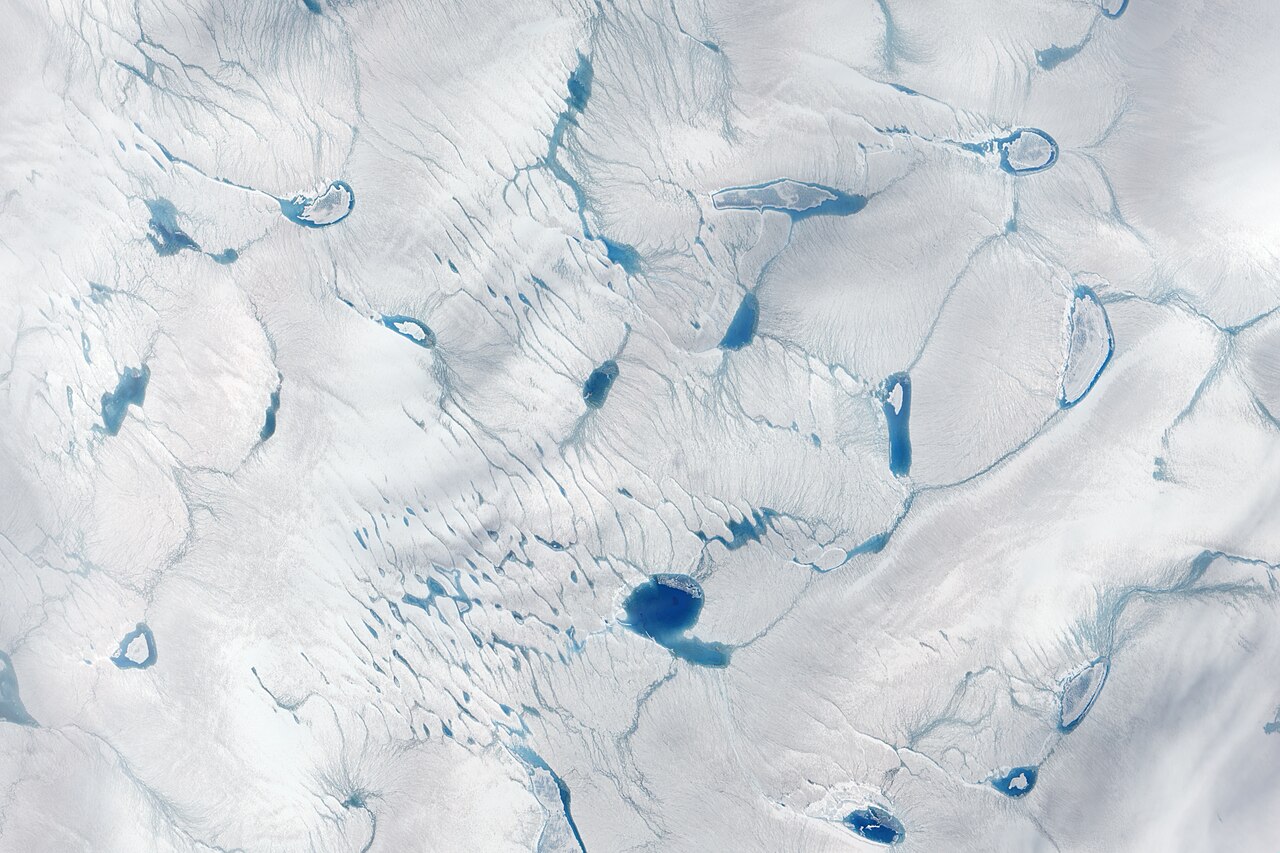
Surface melt is the more visible of the two. Each summer, meltwater gathers in blue lakes and rivers on the ice surface. Some of it drains through cracks called moulins to the bedrock below, where it can lubricate the base of the ice sheet and speed the glaciers’ slide to the sea.
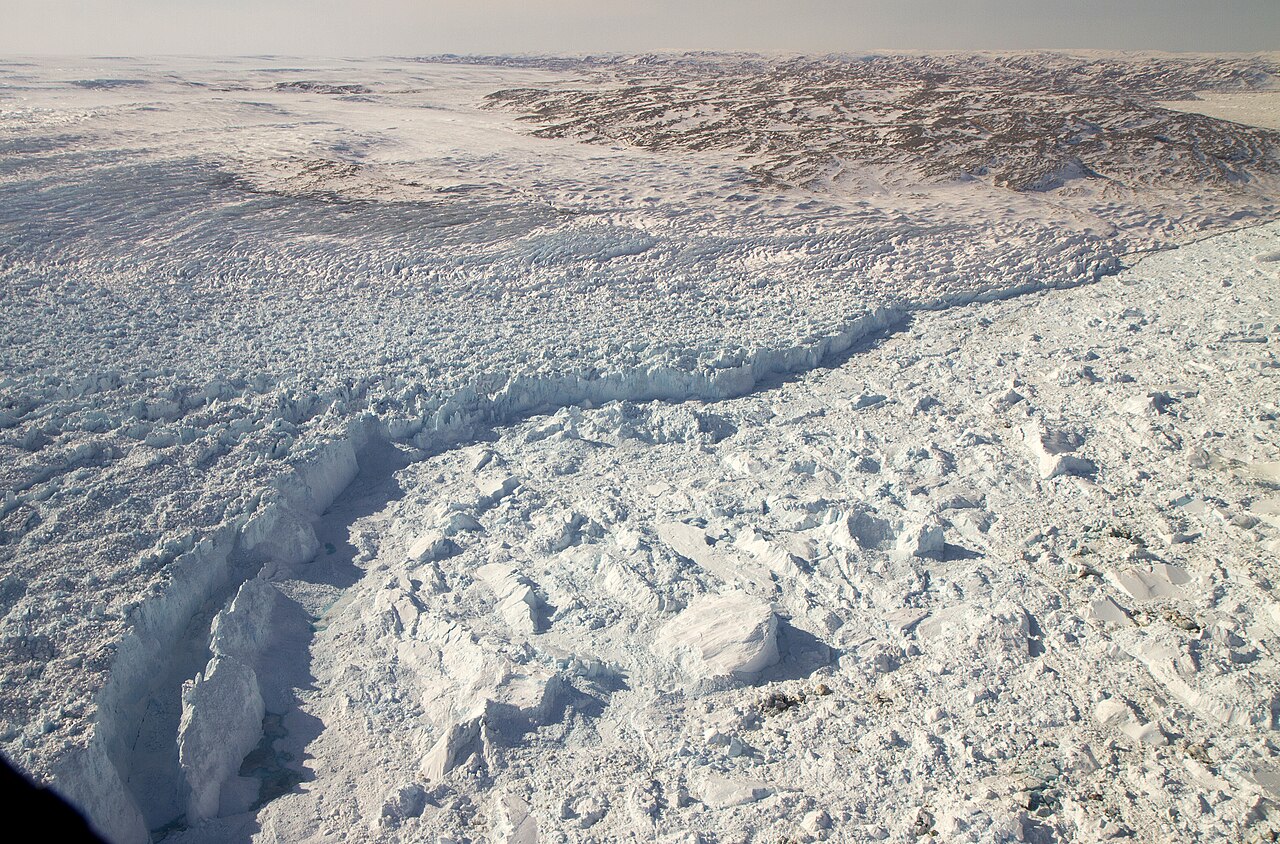
Dynamic loss is less visible but just as important. When the glaciers at the coast thin and retreat, the ice behind them flows faster, like water draining from a basin whose plug has been pulled. Warm ocean water plays a large part here — it melts the glaciers from below, where they meet the sea.
Why is the Greenland ice sheet melting so fast?
There is no single cause. Greenland’s melt is the product of several mechanisms working at once — and several of them amplify each other.
1. The Arctic is warming far faster than the rest of the planet
The first cause is the simplest: the air above Greenland is getting warmer, and it is warming faster than almost anywhere else on Earth. A 2022 study found the Arctic warmed nearly four times as fast as the global average between 1979 and 2021 — about 0.73°C per decade, against 0.19°C globally. This is Arctic amplification: as sea ice and snow disappear, darker ocean and land absorb more sunlight, which warms the region further. Greenland sits in the middle of it.
Warmer air melts ice directly, but it also changes the weather patterns that sit over the island. The same Arctic mechanism helps explain a seeming paradox closer to home — why winters can still be bitterly cold even as the Earth warms.
2. High-pressure systems park warm air over the ice
Greenland’s worst melt years — 2010, 2012, 2019 — shared a weather pattern: a stubborn high-pressure system, or “blocking high”, sitting over the island for weeks, pulling in warm air from the south and holding skies clear so the sun could work on the ice uninterrupted. These blocking patterns are natural, but they now play out against a background of much warmer air, so the same pattern produces far more melt than it would have fifty years ago. In July 2012, the combination melted the surface of about 97 percent of the entire ice sheet. Ice cores show that melting at the summit itself happened on average once every 150 years over the 10,000 years before 1950 — yet it has now happened four times since 1995.
3. The ice itself is getting darker
White snow reflects most sunlight back into space; bare, dark ice absorbs it. As summers warm, the snowline retreats earlier each year and exposes more bare ice. Soot from wildfires and industry darkens the surface further, and so do blooms of dark ice algae that spread across the ice each summer — researchers showed in 2017 that these algae measurably lower the ice’s reflectivity and speed up melting in southwestern Greenland. Every patch of darkened ice absorbs more heat, melts more, and exposes more dark ice: a feedback loop that runs by itself once started.
4. Warm ocean water is eating the glaciers from below
Half of Greenland’s ice loss comes from its coastal glaciers, and the ocean is doing much of the work. Warm Atlantic water flows into the fjords and melts the glaciers where they meet the sea, undercutting them so they calve faster. A study in Nature Geoscience found a second, subtler effect: warm air melts the ice surface, and that meltwater running into the sea stirs the water — like stirring ice cubes in a glass — bringing deeper warm water up against the ice. The researchers calculated that without the warming of the air over recent decades, the retreat of Greenland’s glaciers would have been up to a third smaller.
5. Rain is replacing snow
On 14 August 2021, rain fell on the summit of the Greenland ice sheet for the first time since records began — at a research station 3,216 metres above sea level, a place where precipitation had always fallen as snow. Rain is a double blow: it falls on snow that would otherwise reflect sunlight, darkening the surface, and it releases heat as it freezes in the cold snowpack. Rainfall is becoming more common across Greenland as the Arctic warms, and each rain event now melts ice that snow would have protected.
6. The melt is steady, not just a run of freak summers
It is tempting to blame a few extreme heatwaves, but the research points the other way. A study by scientists at the University of California, Irvine, using weather stations across the ice sheet, found that extreme melt episodes account for only about 2 percent of surface melt since 2007. Most of the loss comes from ordinary, day-to-day processes: wind-driven warm air accounts for about 31 percent of the thaw, and sunshine during clear skies about 28 percent. In other words, Greenland is not melting because of a few bad weeks. It is melting because the everyday weather over the ice has changed.
7. Feedback loops lock the melt in
Several of these mechanisms feed on each other. Darker ice absorbs more heat, which melts more ice and exposes more dark ice. As the surface melts and lowers, it sinks into warmer air, which melts it faster. Meltwater reaching the bed speeds the glaciers, which thins them, which exposes more ice to warm ocean water. Once these loops are running, they keep going even if the original push eases. That is why scientists talk about Greenland’s melt as self-reinforcing rather than a one-off response to a hot year.
The evidence it is speeding up
The satellite record is only two decades long, but ice cores reach back centuries. A Dartmouth College study of ice cores found that melting in western Greenland since the early 1990s is the fastest in at least 450 years. The GRACE record shows the same acceleration in real time. And the milestones keep coming: the 2012 melt across 97 percent of the surface, the 2019 melt season that was second only to 2012, and the first rain at the summit in 2021. Each of these was remarkable on its own; together they describe a system that has shifted into a new state.
What happens if Greenland keeps melting?
The most direct consequence is sea level. Greenland’s melt currently adds about 0.8 millimetres a year to the global oceans — small on its own, but it is the largest single contribution from any land ice, and it is growing. A 2022 study in Nature Climate Change, led by Jason Box of the Geological Survey of Denmark and Greenland, found that the ice sheet is already committed to losing at least 3.3 percent of its volume — enough to raise sea level by at least 27 centimetres — even if the world stopped burning fossil fuels today. If melt years like 2012 became the norm, that committed rise more than doubles, to about 78 centimetres.
Sea level will not rise evenly. Because a melting ice sheet also loses gravitational pull on the surrounding ocean, sea level near Greenland would actually fall, while places far away — the US East Coast, South Asia, small island states — would see a rise roughly 30 percent above the global average. Greenland’s meltwater also flows into the North Atlantic, where scientists are watching closely whether it slows the ocean circulation that keeps western Europe mild. A major British-led project launched in 2026 is measuring that risk directly.
None of this happens overnight. Even the committed 27 centimetres would arrive over decades to centuries, not in a single flood. But sea-level rise is cumulative and, for practical purposes, irreversible on human timescales: the water that reaches the ocean stays there.
Can the melting be stopped?
Not entirely, and not quickly. The committed loss found by Box and colleagues is already baked in: it reflects the gap between the ice sheet’s present shape and the climate it now lives in. What can still change is how much more is added. Cutting greenhouse gas emissions slows the warming that drives every mechanism above — less warm air, less warm ocean water, fewer blocking highs, less rain on snow — and keeps the worst scenarios, like 2012 every year, from becoming normal. Adaptation matters too: the coastal cities and island nations that will feel Greenland’s melt first are already planning for higher seas.
The context makes the stakes plain. At COP31 in Antalya in November 2026, governments formally recognised for the first time that the world is on track to temporarily overshoot the Paris Agreement’s 1.5°C limit — 2024 was already the first single year to average more than 1.5°C above pre-industrial levels. Greenland is one of the clearest places to see what that overshoot means in practice: an ice sheet that took millennia to build, losing mass six times faster than it did in the 1980s, with some of the loss now unavoidable.
The bottom line
Greenland is melting fast because the Arctic is warming fast, the ice is getting darker, the oceans are warming, and the melt feeds on itself. Satellites put the loss at about 264 billion tonnes of ice a year, and at least 27 centimetres of sea-level rise is already committed. The ice sheet will not disappear in our lifetimes — but the melt already under way will shape coastlines for centuries. The question now is not whether Greenland melts, but how much more we add to the loss already locked in.
How much ice is Greenland losing each year?
About 264 billion tonnes a year between 2002 and 2025, according to NASA’s GRACE satellites — enough to raise global sea level by about 0.8 millimetres a year. Independent satellite analyses put the figure in the same range, roughly 240 to 280 billion tonnes a year.
How much would sea level rise if all of Greenland’s ice melted?
About 7 metres (23 feet). That would take centuries, and it is not expected this century — but even a fraction of it matters: Greenland alone is already committed to at least 27 centimetres of rise.
Is Greenland’s ice loss speeding up?
Yes. Ice loss is now about six times faster than in the 1980s, and melting in western Greenland since the early 1990s is the fastest in at least 450 years, according to ice-core records.
Why is Greenland melting faster than Antarctica?
Greenland sits at lower latitudes, and most of its loss is surface melting driven by warm air, which acts fast. Antarctica is colder and higher, and mostly loses ice where warm ocean water reaches its edges — a slower process, though parts of West Antarctica are now losing mass rapidly too.
Can Greenland’s ice sheet recover?
Not on human timescales. The ice sheet is already committed to losing at least 3.3 percent of its volume even if emissions stopped today. Cutting emissions can slow further loss and prevent the worst outcomes, but the melt already under way cannot be reversed.