Xiaomi 18 Pro Max vs Galaxy S26 Ultra: Which Flagship Should You Buy in 2026?
Xiaomi’s new flagship has a question to answer: is a phone with a screen on its back worth €1,599? The Xiaomi 18 Pro Max vs Galaxy S26 Ultra comparison is the flagship fight of late 2026, because these two phones take opposite approaches to the same problem. Xiaomi, launched globally in Paris on November 17, bets on the biggest battery and fastest charging in its class, plus a rear display no other major phone has. Samsung, launched in February, bets on the most complete camera system and the S Pen — and it is lighter, thinner and, in the United States, cheaper at list price.
There is no single winner. The right phone depends on what you actually do with it. This guide compares them head to head — battery, performance, cameras, displays, design, software and price — using the confirmed global specifications of the Xiaomi, so you can decide with facts, not launch hype.
At a glance
| Xiaomi 18 Pro Max (global) | Samsung Galaxy S26 Ultra | |
|---|---|---|
| Price from | €1,599 (12GB / 256GB) | $1,299.99 (256GB) |
| Display | 6.9-inch LTPO AMOLED, 120Hz, up to 4,000 nits peak; rear secondary display | 6.9-inch QHD+ Dynamic LTPO AMOLED, 1–120Hz, 2,600 nits peak; Gorilla Armor 2 |
| Chip | Snapdragon 8 Elite Extreme Gen 6 (2nm) | Snapdragon 8 Elite Gen 5 for Galaxy |
| RAM / storage | 12GB or 16GB / 256GB, 512GB or 1TB | 12GB / 256GB, 512GB or 1TB |
| Battery | 7,050mAh (global; 8,500mAh in China) | 5,000mAh |
| Charging | 100W wired, 50W wireless | 60W wired, 25W wireless |
| Rear cameras | 200MP main + 200MP periscope (3.2x) + 50MP ultrawide, Leica | 200MP main (f/1.4) + 50MP ultrawide + 50MP periscope (5x) + 10MP telephoto (3x) |
| Front camera | 50MP | 12MP |
| Weight / thickness | ~235g, 8.4mm (Chinese listing; global figures not separately confirmed) | 214g, 7.9mm |
| Extras | Rear display, Privacy Mode | S Pen built in, Privacy Display, IP68 |
| Software | HyperOS 4 (Android 17) | One UI 8.5 (Android 16) |
Battery and charging: Xiaomi wins by a wide margin
This is the clearest gap between the two phones, and it survives the one piece of bad news in Xiaomi’s global launch. The global 18 Pro Max has a 7,050mAh battery — smaller than the 8,500mAh cell in the Chinese model, a cut Xiaomi has not publicly explained. Even so, it holds 41% more capacity than the Galaxy S26 Ultra’s 5,000mAh battery. In practice, that is the difference between ending a heavy day with charge to spare and reaching for a charger in the evening.
Charging widens the gap further. The Pro Max charges at 100W wired and 50W wireless; the S26 Ultra manages 60W wired and 25W wireless. A phone that charges this fast changes how you use it: ten minutes on the charger while you make coffee can add hours of use, and the wireless gap matters just as much if you charge on a pad overnight or at your desk.
Two honest caveats. First, capacity is not the same as battery life: screen brightness, the chip’s efficiency and software all matter, and independent battery tests of the global Xiaomi have not been published yet. Second, a bigger battery is also a bigger battery to wear out — if you want the cell to last years rather than months, the habits in our guide to why your phone battery drains so fast matter whichever phone you buy. But on the numbers that are confirmed, Xiaomi wins this round outright.
Performance: a newer chip, a generation ahead
The Pro Max runs Qualcomm’s Snapdragon 8 Elite Extreme Gen 6, built on a 2-nanometre process. The S26 Ultra runs the Snapdragon 8 Elite Gen 5 for Galaxy — one generation older, on an older process node. A newer process node usually means the same performance for less power, or more performance for the same power, and that is exactly what a phone with a huge battery and a bright screen needs.
How much of that shows up in daily use is a narrower question. Both chips are far faster than any app or game most people run, and the S26 Ultra has spent nine months proving itself in the real world while the Xiaomi’s chip is brand new. The practical difference will show in sustained heavy work — long gaming sessions, video editing, on-device AI — and in efficiency over a full day, where the newer chip should sip less power. If you keep a phone for three or four years, buying the newer silicon is the safer long-term bet. If you upgrade every year or two, it barely matters.
Memory is a tie in most configurations: both offer 12GB of RAM with 256GB or 512GB of storage, and both go up to 1TB. The Xiaomi’s top configuration pairs 1TB with 16GB of RAM. If you are weighing storage sizes, our guide to how much storage you actually need uses laptops as the example, but the logic — 256GB is fine for most people, 512GB for heavy photo and video use — applies to phones too. And 12GB of RAM is the right baseline in 2026; our guide to how much RAM you need explains why more than that only matters for the heaviest workloads.
Cameras: Xiaomi’s lenses vs Samsung’s zoom
Both phones have a 200MP main camera, and both will take excellent photos in daylight. The difference is in what sits beside it.
Xiaomi’s system is simpler and, in one way, stronger: two 200MP Leica cameras — a main sensor and a periscope — plus a 50MP ultrawide. The headline is the periscope: a 200MP sensor behind a 3.2x lens gathers far more detail than the small telephoto sensors most phones use, and Leica’s colour tuning has a distinctive look that many photographers prefer straight out of the camera. The 50MP front camera is also far higher resolution than Samsung’s 12MP selfie camera, which matters if you take a lot of self-portraits or video calls — and the rear display lets you take those selfies with the main cameras instead.
Samsung’s system is more versatile. Its quad camera adds a 50MP periscope with 5x optical zoom and a 10MP 3x telephoto, giving it two true optical zoom steps where Xiaomi has one. At 5x and beyond, the S26 Ultra will resolve detail the Xiaomi can only reach by cropping its 3.2x image — Samsung’s 100x Space Zoom is mostly a party trick, but the 5x step is genuinely useful for concerts, wildlife and travel. The main camera’s f/1.4 aperture is also the widest on any flagship, which helps in low light.
The honest summary: Xiaomi wins on the main camera’s resolution and on selfies; Samsung wins on zoom range. If you photograph distant subjects, buy the Samsung. If you shoot portraits and street photography with the main lens, the Xiaomi’s Leica system is at least its equal.
Displays: a screen on the back vs a pen in the side
The Xiaomi’s signature feature is its rear secondary display, and it is not a gimmick in the way rear screens used to be. It shows the time, notifications and a live preview from the rear cameras, so you can frame a selfie with the 200MP main camera and see yourself doing it. Xiaomi’s slogan for it is “Back for more”, and it is the single most recognisable thing about the phone — you can spot it from across a room.
Samsung’s answer is the S Pen, built into the phone’s body. It is a stylus for notes, sketches, precise photo editing and remote camera control, and for the people who use it, no other phone offers anything like it. It is also the reason the S26 Ultra is the better productivity phone: annotating a document or signing a PDF with a pen beats doing it with a fingertip.
The main displays are closely matched. Both are 6.9-inch LTPO AMOLED panels running at up to 120Hz. Xiaomi’s peaks brighter — up to 4,000 nits against Samsung’s 2,600 — which helps outdoors in direct sunlight. Samsung’s panel has Gorilla Armor 2, which cuts reflections as well as resisting scratches, and both phones now have a privacy mode that makes the screen harder to read from an angle — useful on a train or a plane, and a rare case of both makers arriving at the same idea at once.
Design and feel: Samsung is lighter and thinner
Here Samsung wins clearly. The S26 Ultra weighs 214g and is 7.9mm thick. The Xiaomi Pro Max is around 235g and 8.4mm thick, according to Xiaomi’s Chinese listing — global weight figures were not separately confirmed at the Paris event. Twenty grams does not sound like much, but in a phone you hold for hours a day, it is the difference between a phone that disappears in the hand and one you notice.
Both phones come in understated colours — Xiaomi offers Black, White, Velvet Red and Cosmic Blue — and both are large, flat-edged slabs. Neither is a small phone, and neither pretends to be. If you have small hands or you carry your phone in a jacket pocket rather than a bag, the Samsung’s slimmer body is the more comfortable choice.
Software: newer Android vs longer-proven software
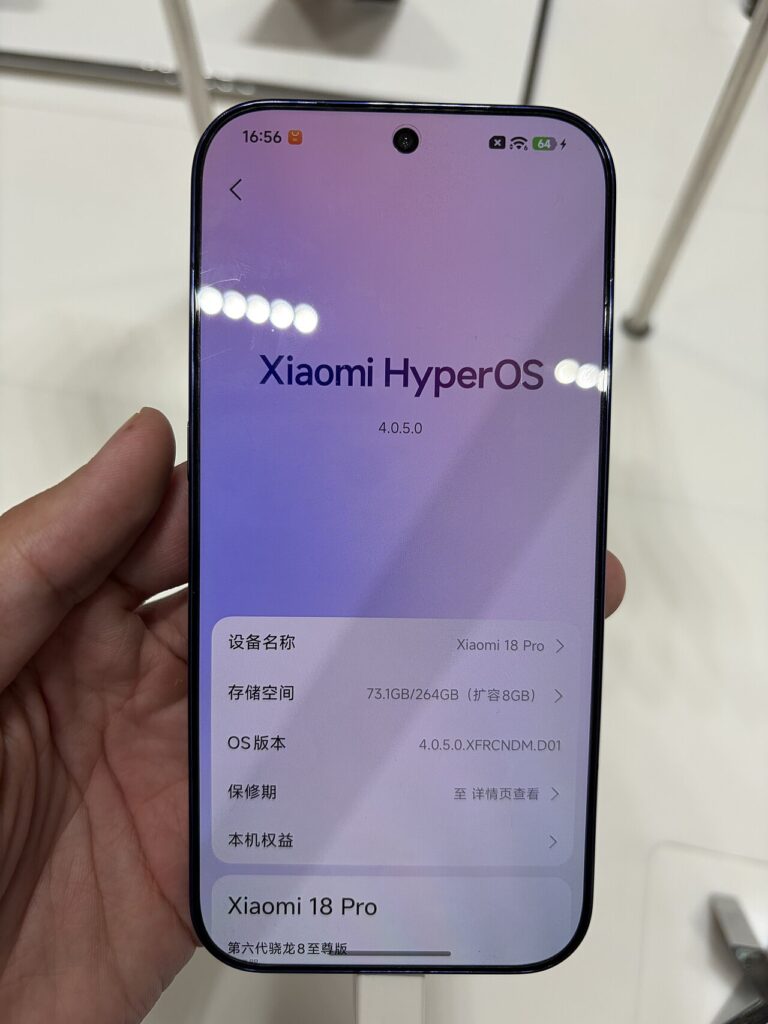
The Xiaomi ships with HyperOS 4, based on Android 17 — the newest version of Android available on any phone. The S26 Ultra runs One UI 8.5 on Android 16. Xiaomi’s newer base is a small advantage, but Samsung’s software is the more proven quantity: One UI is the most polished Android skin, with the best large-screen multitasking and the longest track record of monthly updates. Xiaomi has improved HyperOS a great deal, but its update history is shorter and less consistent than Samsung’s seven-year update promise.
Buyers also get a free three-month trial of Google AI Pro and YouTube Premium, a four-month Spotify Premium trial and a short iQIYI VIP trial with the Xiaomi — a nice bundle, though it is a trial, not a permanent feature. Our news coverage of the launch has the full confirmed price and battery details.
Price and value: read the numbers carefully
The Xiaomi 18 Pro Max starts at €1,599 for 12GB and 256GB, rising to €1,799 for 512GB. The Galaxy S26 Ultra launched at $1,299.99 for 256GB. Those two numbers are not directly comparable: European prices include sales tax, American prices do not, and the phones are sold in different markets with different currencies. What can be said plainly is that the Xiaomi is the more expensive phone at list price in its home market, and that the Samsung — nine months into its life — is now frequently discounted. Sale prices are not list prices, and a discounted S26 Ultra can cost several hundred dollars less than the Xiaomi’s launch price.
Value, then, depends on when you buy. At launch, the Xiaomi asks a premium for the newest chip, the biggest battery and the rear display. The Samsung asks less for a more complete camera system, the S Pen and a lighter body — and it is available now, with reviews, long-term battery data and known resale value, while the Xiaomi’s real-world battery life and durability are still untested outside China.
Who should buy which?
Buy the Xiaomi 18 Pro Max if battery life and charging speed are your top priorities; if you want the newest chip and the newest Android; if you take a lot of selfies and want to take them with the main cameras; or if you want a phone that looks and feels different from every other flagship.
Buy the Galaxy S26 Ultra if you photograph distant subjects and need 5x zoom; if you use a stylus for notes, sketches or document work; if you want the lighter, thinner phone; if you value Samsung’s long update history; or if you can find it discounted, which makes the value argument very hard to beat.
Frequently asked questions
Is the Xiaomi 18 Pro Max battery really bigger than the Galaxy S26 Ultra’s?
Yes. The global Pro Max has a 7,050mAh battery against the S26 Ultra’s 5,000mAh — 41% more capacity. Note that the Chinese Pro Max has an even bigger 8,500mAh cell; the global model is smaller, but still far ahead of Samsung.
Does the Xiaomi 18 Pro Max have a better camera than the Galaxy S26 Ultra?
It depends on what you shoot. Xiaomi’s dual 200MP Leica system is stronger on the main camera and selfies; Samsung’s quad system is stronger on zoom, with a 5x periscope against Xiaomi’s 3.2x. Neither is better at everything.
What is the rear display on the Xiaomi 18 Pro Max for?
It is a small secondary screen on the back of the phone. It shows the time and notifications, and it gives you a live preview when you take selfies with the rear cameras — so you can use the 200MP main camera for self-portraits instead of the front camera.
Is the Xiaomi 18 Pro Max available in the United States?
No. Xiaomi did not announce a US launch, and it does not sell its phones officially in the US. The global launch covers Europe and selected markets in Asia and elsewhere; American buyers would need to import one.
Which phone is better for gaming?
The Xiaomi has the newer, more efficient chip and the much bigger battery, so it should last longer in long sessions and charge faster between them. The Samsung has a more mature gaming ecosystem and nine months of real-world testing behind it. For marathon gaming, the Xiaomi’s battery is the deciding factor.
The bottom line
The Xiaomi 18 Pro Max is the more exciting phone: the biggest battery in its class, the fastest charging, the newest chip and a rear display that no rival can match. The Galaxy S26 Ultra is the more complete phone: better zoom, the S Pen, a lighter body, proven software and a lower price — especially discounted. If you want the future, buy the Xiaomi. If you want the finished product, buy the Samsung. Either way, check the real-world battery tests of the global Xiaomi before you spend €1,599: the 7,050mAh cell is a big number, but it is not the 8,500mAh cell Xiaomi sells at home, and that difference deserves a test, not a guess.