Antibiotic Resistance: Causes, Stats & What’s Next
Antibiotic resistance killed 1.27M people in 2019 and could kill 39M by 2050. This complete guide explains the causes, latest research, and what’s next.
Antibiotics are among the most consequential medical discoveries in human history. Before they existed, a scraped knee, childbirth, or a routine surgery could easily turn fatal. Today, that protection is eroding. Bacteria are evolving faster than our drugs can keep up, and infections that were once easily curable are becoming untreatable.
This guide explains antibiotic resistance in full: what it is, why it happens, what the newest research shows, the numbers that define the crisis, what it means for you, and where the science is heading.
1. What Antibiotic Resistance Is
Antibiotic resistance occurs when bacteria change in ways that make antibiotics ineffective against them. The drugs still exist and still work against susceptible bacteria — but the resistant strains survive treatment, multiply, and spread.
It is important to be precise about who becomes resistant. People do not become resistant to antibiotics; bacteria do. A person carrying a resistant infection cannot be treated with the standard drug, but the resistance belongs to the microbe, not the patient.
Resistance is also distinct from tolerance or treatment failure for other reasons. A resistant infection is one in which the bacterium possesses a specific, heritable mechanism — a mutated protein, a drug-destroying enzyme, a pump that expels the drug — that lets it survive concentrations of antibiotic that would kill its susceptible counterparts.
Resistance exists on a spectrum. Some bacteria resist one drug. Multidrug-resistant (MDR) organisms resist several. Extensively drug-resistant (XDR) organisms resist nearly all available options. At the far end are strains resistant to every known antibiotic — infections for which medicine currently has no answer.
2. Why It Happens
Resistance is not a malfunction of nature. It is evolution, operating exactly as expected — accelerated by human behavior.
Spontaneous mutation
Bacteria reproduce astonishingly fast; a single E. coli can divide every 20 minutes under ideal conditions. Each division carries a small chance of random genetic mutation. Most mutations are harmless or fatal to the bacterium. But occasionally, one alters the bacterium’s structure just enough to blunt an antibiotic’s effect — changing the shape of the protein the drug targets, for example. When the antibiotic kills off the susceptible majority, that lucky mutant survives, reproduces, and its descendants inherit the advantage. This is natural selection in its purest form.
Horizontal gene transfer
Bacteria do not have to wait for lucky mutations. They can trade resistance genes directly with each other — even across species — through three mechanisms:
- Conjugation: two bacteria connect via a bridge-like structure and pass circular DNA fragments (plasmids) carrying resistance genes.
- Transformation: a bacterium picks up free-floating DNA from dead bacteria in its environment.
- Transduction: viruses that infect bacteria (bacteriophages) accidentally ferry resistance genes between hosts.
This gene-swapping is why resistance spreads so quickly and unpredictably. A resistance gene that evolves in a harmless gut bacterium can end up in a pathogen causing pneumonia within the same patient.
Overuse and misuse in human medicine
Every course of antibiotics applies selection pressure: it kills susceptible bacteria and leaves resistant ones standing. The more antibiotics are used — and the more they are used inappropriately — the faster resistance spreads. Major drivers include:
- Prescribing antibiotics for viral infections (colds, flu, most sore throats), against which they have no effect.
- Patients stopping courses early, leaving the hardiest bacteria alive. (Note: emerging evidence suggests shorter courses are sometimes equally effective — see the research section — but stopping without medical guidance remains risky.)
- Over-the-counter sales without prescription, common in many low- and middle-income countries.
- Use of broad-spectrum antibiotics where narrow-spectrum ones would suffice, killing beneficial bacteria along with the target.
Agriculture and the environment
Antibiotics are used in large quantities in livestock farming — for treatment, disease prevention, and historically for growth promotion. Resistant bacteria from animals reach humans through food, water, direct contact, and the environment. The World Health Organization identifies agricultural antibiotic use as a significant driver of resistance and has called for its reduction worldwide.
3. What the Latest Research Says
The global burden, measured precisely
The most authoritative estimates of resistance-related deaths come from the Global Research on Antimicrobial Resistance (GRAM) Project, a collaboration between the Institute for Health Metrics and Evaluation (IHME) and the University of Oxford.
Their first landmark analysis, published in The Lancet in 2022, estimated that 1.27 million deaths were directly attributable to bacterial antimicrobial resistance in 2019 — meaning those people would have survived if their infections had been drug-susceptible. A further 4.95 million deaths were associated with resistant infections. For comparison, HIV/AIDS and malaria caused an estimated 860,000 and 640,000 deaths respectively that same year. Six pathogens — Escherichia coli, Staphylococcus aureus, Klebsiella pneumoniae, Streptococcus pneumoniae, Acinetobacter baumannii, and Pseudomonas aeruginosa — accounted for 929,000 of the attributable deaths. Methicillin-resistant S. aureus (MRSA) alone caused more than 100,000. (1)
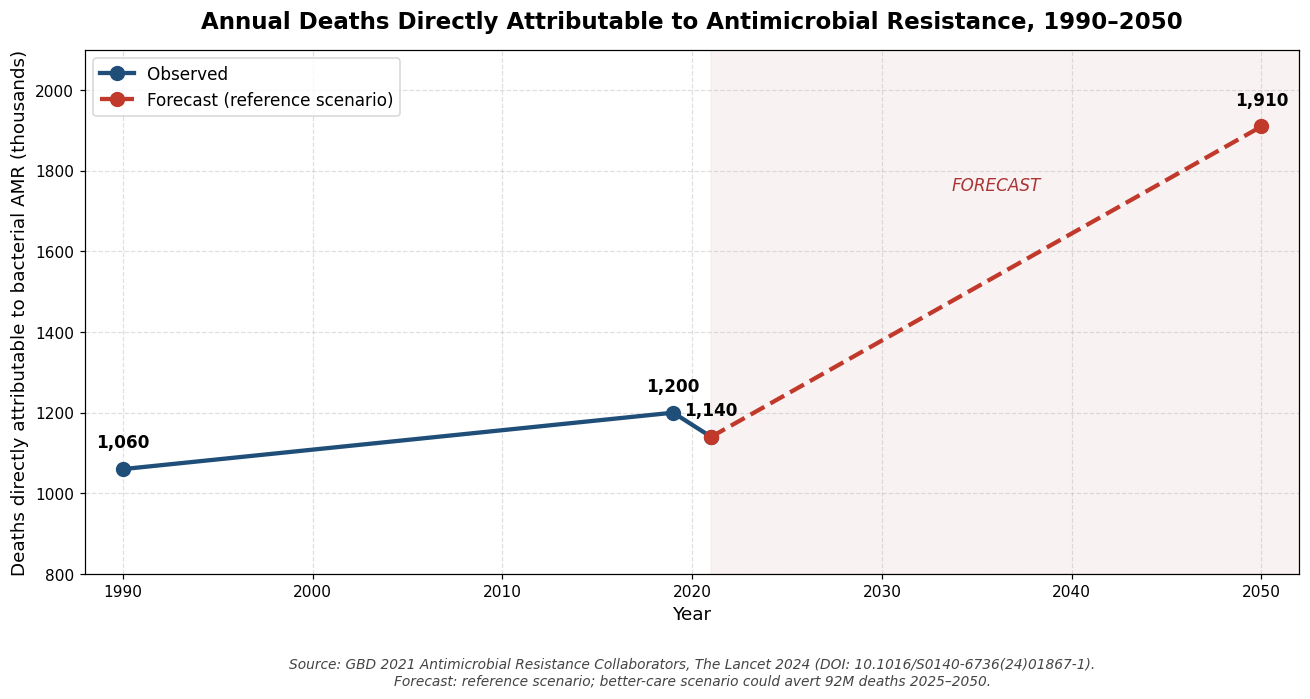
Their follow-up study, published in The Lancet in September 2024, extended the analysis across 1990–2021 using 520 million individual records, and forecasted to 2050. Key findings:
- More than one million people died from AMR every year between 1990 and 2021; 1.14 million died in 2021 alone.
- Without further action, annual deaths are projected to rise nearly 70% to 1.91 million by 2050, with 39 million cumulative deaths between 2025 and 2050.
- Deaths among children under five fell by half since 1990 (a public-health success driven by vaccination and sanitation), while deaths among adults over 70 more than doubled — a pattern expected to intensify as populations age.
- Resistance to carbapenems — the antibiotics of last resort for many infections — caused 216,000 attributable deaths in 2021, up from 127,000 in 1990.
- Crucially, the study modeled interventions: better hospital care and antibiotic access could avert 92 million deaths between 2025 and 2050. (2)
New antibiotics alone are not saving more lives — yet
A sobering NIH-funded study published in The Lancet Infectious Diseases in 2026 examined 5,065 difficult-to-treat Gram-negative infections across 471 US hospitals from 2016 to 2023. Use of six recently approved antibiotics rose nearly 300% over the period — but adjusted in-hospital mortality did not fall. More than three-quarters of patients initially received antibiotics that were inactive against their pathogen. The authors concluded that new drugs, without faster diagnostics and better stewardship, are insufficient on their own. (3)
Combination therapy shows promise against a nightmare pathogen
In a brighter finding, Monash University researchers reported in The Lancet Microbe (2026) that pairing two common β-lactam antibiotics — ceftolozane-tazobactam and meropenem — could kill extensively drug-resistant Pseudomonas aeruginosa (the high-risk ST235 clone) and suppress further resistance emergence in a validated laboratory infection model. The work is preclinical, but it demonstrates a path forward: smarter use of existing drugs, guided by the pathogen’s resistance profile, rather than waiting for entirely new ones. (4)
WHO’s priority list
In 2024, the World Health Organization updated its Bacterial Priority Pathogens List — the global R&D agenda for new antibiotics, identifying the drug-resistant bacteria that pose the greatest threat to public health and most urgently need new treatments. (5)
4. Numbers That Matter
- 1.27 million — deaths directly caused by drug-resistant bacterial infections worldwide in 2019 (GRAM Project, The Lancet 2022).
- 4.95 million — deaths associated with resistant infections in 2019; resistance played a role even where it was not the direct cause.
- 39 million — projected cumulative deaths directly attributable to AMR between 2025 and 2050 without further action (GRAM, The Lancet 2024).
- 1.91 million — projected annual AMR deaths by 2050, up ~70% from 2021.
- 92 million — deaths that could be averted 2025–2050 through better care of severe infections and improved antibiotic access.
- 2.8 million+ — antibiotic-resistant infections each year in the United States, causing 35,000+ deaths (CDC, 2019 AR Threats Report). Including C. difficile, the toll exceeds 3 million infections and 48,000 deaths.
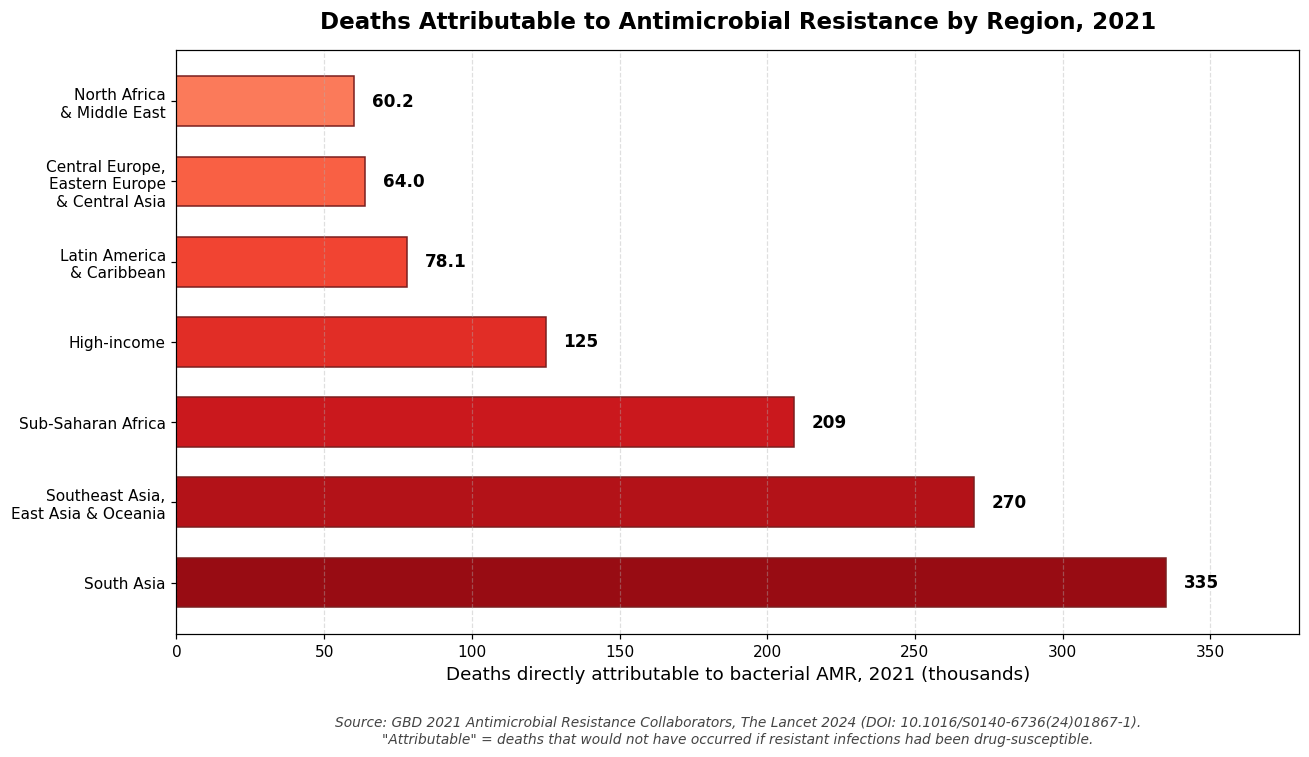
- ~1 in 5 — share of AMR-attributable deaths occurring in children under five, concentrated overwhelmingly in sub-Saharan Africa and South Asia.
- Highest burden — sub-Saharan Africa and South Asia carry the highest AMR death rates; high-income regions the lowest, though no region is spared.
5. What It Means for You
Antibiotic resistance is not a distant or abstract threat. It affects the safety of everyday medicine: joint replacements, organ transplants, cancer chemotherapy, caesarean sections, and premature-baby care all depend on effective antibiotics to prevent and treat infections. As resistance grows, these procedures become riskier.
What you can do:
- Take antibiotics exactly as prescribed — the right dose, at the right times, for the full course your clinician recommends.
- Never demand antibiotics for colds or flu — they treat bacterial infections, not viruses, and unnecessary use drives resistance.
- Never share antibiotics or use leftovers — the drug, dose, and duration were chosen for a specific person and infection.
- Prevent infections in the first place — vaccination, hand hygiene, and safe food handling reduce the need for antibiotics at all.
6. What’s Next
The pipeline of entirely new antibiotic classes is thin — most “new” antibiotics of the past decade are modifications of existing ones, and bacteria often evolve resistance to them quickly. The research frontier has therefore widened beyond simply inventing new drugs:
- Phage therapy: viruses that naturally prey on bacteria are being tested as precision treatments for resistant infections, with clinical trials underway in several countries and established compassionate-use programs.
- Combination and precision therapy: as the Monash study above shows, pairing existing drugs based on a pathogen’s resistance profile can succeed where single drugs fail — especially when guided by rapid diagnostics.
- Rapid diagnostics: tests that identify the pathogen and its resistance genes within hours (rather than days) would let clinicians choose the right drug immediately — addressing the “discordant therapy” problem the NIH study identified.
- Vaccines: preventing bacterial infections outright reduces antibiotic use. Vaccines against resistant pathogens are an active research priority.
- Stewardship programs: hospital and national programs that monitor, restrict, and guide antibiotic prescribing have already cut resistant-infection deaths in US hospitals by nearly 30% since 2013, according to the CDC.
- Global coordination: the 2024 UN General Assembly high-level meeting on AMR and WHO’s updated priority pathogens list signal growing political commitment — though funding for national action plans remains uneven.
The GRAM forecast is not destiny. Its “better care” scenario shows tens of millions of deaths are preventable with tools that already exist.
7. Frequently Asked Questions
Can antibiotic resistance be reversed?
Partially, in some settings. When antibiotic use declines, susceptible strains can regain their competitive advantage — several countries have documented falling resistance rates after restricting specific drugs. But resistance genes rarely vanish entirely; they persist at low levels in bacterial populations and can resurge. Reversal is slow and incomplete, which is why prevention matters more than cure.
Which infections are hardest to treat?
Bloodstream infections and pneumonias caused by carbapenem-resistant Klebsiella pneumoniae or Acinetobacter baumannii, extensively drug-resistant Pseudomonas aeruginosa, and methicillin-resistant Staphylococcus aureus (MRSA) rank among the most difficult. Drug-resistant tuberculosis and drug-resistant gonorrhoea are major global concerns. WHO’s 2024 Bacterial Priority Pathogens List is the authoritative ranking.
Do antibiotics work against colds, flu, or COVID-19?
No. These are viral infections, and antibiotics target bacteria. Taking antibiotics for a viral illness provides no benefit and contributes to resistance — while also disrupting your beneficial microbiome.
Why can’t pharmaceutical companies just make new antibiotics?
They can, but the economics are broken. A new antibiotic costs over a billion dollars to develop, yet must be used sparingly (to preserve its effectiveness) — the opposite of the blockbuster-drug business model. Many large pharmaceutical firms have abandoned antibiotic R&D. New incentive models, such as subscription-style payments piloted in the UK, are being tested.
Is antibiotic resistance contagious — can it spread from person to person?
Resistant bacteria spread exactly like other bacteria: through direct contact, contaminated surfaces, food, water, and healthcare settings. What spreads is the resistant organism (or its genes), not “resistance” as a condition. Good hygiene and infection control limit transmission.
Are there alternatives to antibiotics?
Several are in development: bacteriophage therapy, antimicrobial peptides, antibodies that neutralize bacterial toxins, and vaccines. None yet replaces antibiotics at scale, but combination approaches — new drugs plus rapid diagnostics plus stewardship — represent the most realistic near-term path.
References
- Antimicrobial Resistance Collaborators. Global burden of bacterial antimicrobial resistance in 2019: a systematic analysis. The Lancet. 2022;399(10325):629–655. https://doi.org/10.1016/S0140-6736(21)02724-0
- GBD 2021 Antimicrobial Resistance Collaborators. Global burden of bacterial antimicrobial resistance 1990–2021: a systematic analysis with forecasts to 2050. The Lancet. 2024;404(10459):1199–1226. https://doi.org/10.1016/S0140-6736(24)01867-1
- Walker MK et al. Survival trends in patients with difficult-to-treat, antibiotic-resistant, Gram-negative infections in the era of next-generation antibiotics in the USA: a retrospective cohort study. The Lancet Infectious Diseases. 2026;26(7):659–670. https://doi.org/10.1016/S1473-3099(26)00020-4
- Breen SKJ et al. Dual β-lactam therapy against high-risk Pseudomonas aeruginosa isolates: a dynamic in-vitro infection model study. The Lancet Microbe. 2026. https://doi.org/10.1016/j.lanmic.2026.101364
- World Health Organization. WHO bacterial priority pathogens list, 2024: bacterial pathogens of public health importance to guide research, development and strategies to prevent and control antimicrobial resistance. Geneva: WHO; 2024. https://www.who.int/publications/i/item/9789240093461
- US Centers for Disease Control and Prevention. Antibiotic Resistance Threats in the United States, 2019. Atlanta: CDC; 2019.
Charts in this article were produced from data published in reference 2. Last updated: October 2026.