What Is Bronze Disease? A Deep Dive Into the Corrosion That Eats Ancient Bronze
A bronze statue can survive two thousand years buried in the ground and then fall apart in a museum drawer. That is the strange cruelty of bronze disease. It is not a disease at all — no germs are involved, and it cannot spread from one object to another like an infection. It is a chemical cycle, driven by chloride salts, water and oxygen, that feeds on the bronze itself. Once it starts, it makes its own acid, and the acid makes more of the corrosion that made the acid. Left alone, it can reduce a solid bronze to a heap of blue-green dust.
Conservators dread it more than almost any other kind of damage, because it is active, self-sustaining and — in the strict sense — incurable. The metal already lost can never be put back. What treatment can do is break the cycle and freeze the object in its surviving state. This guide explains how bronze disease works, step by step, how to tell it apart from the harmless green of a healthy patina, what the science says about stopping it, and why even the best treatment comes with honest limits. For the gentler side of the story — how copper turns green in the first place, and why that green usually protects the metal — see our complete guide to why copper turns green.
The short answer
Bronze disease is a self-feeding cycle of chloride corrosion. Chloride salts from burial soil or seawater get into a bronze object and form nantokite, a copper chloride, hidden under the surface. When the object is excavated and exposed to moist air, the nantokite reacts with water and oxygen to form powdery green copper chlorides — and hydrochloric acid. The acid attacks fresh bronze, making more nantokite, and the cycle repeats. The three things it needs are chlorides, water and oxygen; remove any one of them and the cycle stalls, but the damage already done is permanent.
Patina is protection. Bronze disease is the opposite.
To understand bronze disease, it helps to start with what it is not. Most old bronze wears a green coat — malachite, brochantite or atacamite — that forms slowly in air, rain and soil. That coat is patina, and it is stable: it sticks tightly to the surface, seals the metal underneath, and can keep a bronze standing for centuries. The Statue of Liberty has worn hers since 1906. Conservators value patina so much that stripping it off an object is considered damage in itself.
Bronze disease looks similar at a glance — green, sometimes blue-green — but it behaves in the opposite way. It is powdery where patina is smooth, it grows in isolated patches where patina covers evenly, and it eats inward instead of sealing outward. The giveaway is texture and behaviour: a light-green powder that brushes off, returns after cleaning, and sits over pits eaten into the metal is active corrosion, not patina. A hard, smooth green skin that has sat unchanged for decades is almost certainly patina. The two can sit side by side on the same object, which is exactly why diagnosis matters — and why the standard advice is never to scrub a green bronze clean on a guess.
The distinction is chemical, not just visual. Patina minerals — cuprite, malachite, brochantite — are stable end-products: once formed, they mostly sit there. Bronze disease is driven by a compound that is not stable in air at all. That compound is the whole story.
Where the chlorides come from
Bronze is mostly copper, usually with about a tenth tin, and sometimes lead or zinc. Pure copper and clean bronze do not develop bronze disease on their own — the chloride has to come from somewhere. In practice it almost always comes from the object’s history.
The commonest source is burial. Soils in many regions carry chloride salts, and a bronze buried for centuries soaks them up. Seawater is the other great source: bronzes recovered from shipwrecks, or from coastal sites, are steeped in salt. But chlorides reach bronze in quieter ways too — road salt on an outdoor monument, sweat from bare hands, residues from old cleaning products, even the slow release of hydrogen chloride gas from degrading PVC storage materials. Museums have learned to keep chlorides away from bronzes the way hospitals keep infections away from wards: not because the risk is exotic, but because it is ordinary.
What matters is not just that chlorides are present, but where they end up. Chloride ions are small and mobile. In damp, low-oxygen burial conditions they migrate inward through the corrosion layers toward the metal surface, while copper ions migrate outward. The two meet just above the surviving metal — and that meeting is where the trouble is manufactured.
The nantokite cycle: how bronze eats itself
The chemistry of bronze disease is a loop with four steps, and the loop is the point: each turn manufactures the ingredients for the next one.
Step 1: copper becomes cuprous chloride. In the burial environment, copper at the metal surface oxidises to the cuprous ion, Cu⁺, which meets chloride ions and forms cuprous chloride, CuCl — the mineral nantokite. Nantokite is a waxy, grey-white solid. Crucially, it forms underneath the outer patina, pressed against the surviving metal, where there is little oxygen and little water. As long as it stays sealed away from air, it is stable, and the object can sit in the ground for millennia without visible harm.
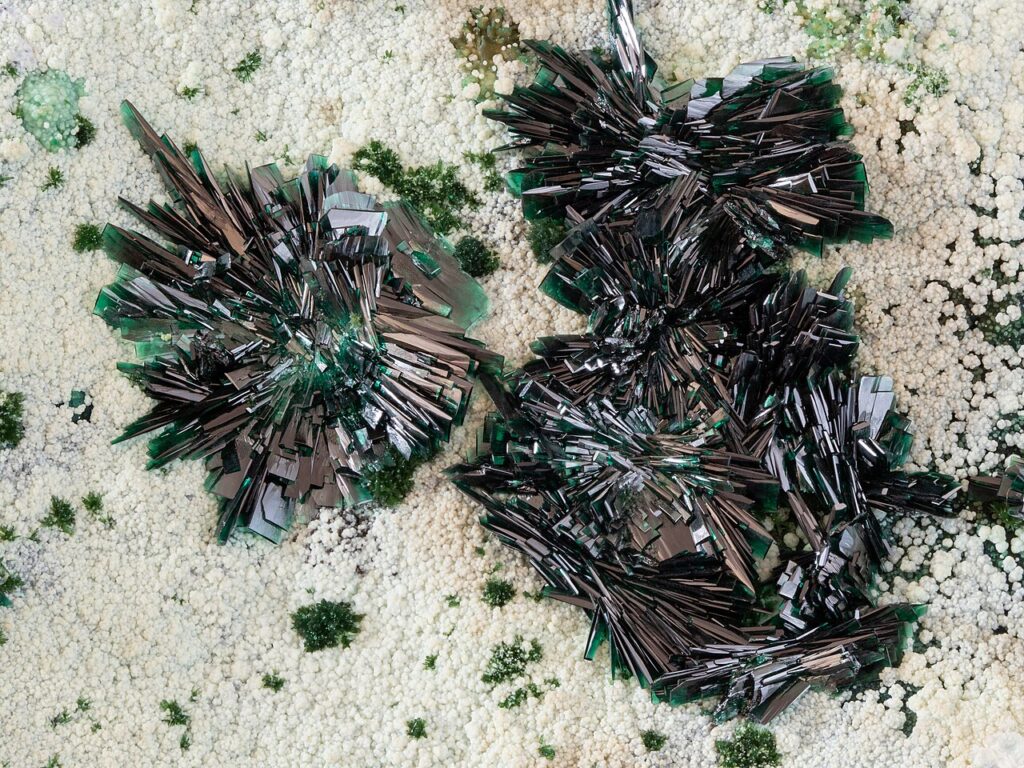
Step 2: excavation wakes it up. Once the object is dug up, oxygen and water vapour from the air reach the nantokite through pores and cracks in the overlying patina. Water and oxygen together convert it into green copper trihydroxychlorides — atacamite, paratacamite, botallackite and clinoatacamite, four minerals that share the formula Cu₂(OH)₃Cl — and, in the same reaction, hydrochloric acid:
4 CuCl + 4 H₂O + O₂ → CuCl₂·3 Cu(OH)₂ + 2 HCl
Step 3: the products erupt. The trihydroxychlorides occupy much more volume than the nantokite they came from. That expansion has nowhere to go, so the green powder forces its way up through the patina and bursts out on the surface as pale, powdery, blue-green patches — the classic visible sign of the disease. The eruption also cracks the patina further, letting in more air and moisture.
Step 4: the acid makes more nantokite. The hydrochloric acid released in step 2 attacks fresh copper, producing more cuprous ions, which meet the chloride the acid carried and form more nantokite. The loop closes. Each cycle consumes a little more of the original metal and produces a little more green powder and a little more acid.
Two features make this cycle so destructive. First, the chloride is not consumed: it is recycled, acting more like a catalyst than a reactant, so a small amount of salt can drive a large amount of damage. Second, the reaction is autocatalytic — it accelerates itself — which is why conservators describe bronze disease as “nearly inexorable” once it is established. Wikipedia‘s summary is blunt: the process is “irreversible and nearly inexorable”. The metal that becomes green powder is gone; no treatment puts it back.
It is also worth saying plainly what bronze disease is not. It is not contagious. The name is a metaphor from the nineteenth century, and it misleads people into quarantining objects as if they carried germs. An infected bronze cannot give the disease to a healthy one — but its powdery corrosion products are chloride-rich dust, and if that dust settles on another chloride-contaminated bronze in damp air, it can feed that object’s own cycle. That is why museums isolate affected pieces: not because of infection, but because of chemistry and housekeeping.
Why it wakes up after excavation
One of the cruellest features of bronze disease is its timing. A bronze can lie in the ground for two thousand years looking, on excavation, almost intact — and then start to crumble within months of reaching a museum shelf. The reason is the burial paradox: the same conditions that preserved the object are what armed the trap.
Underground, oxygen is scarce. Nantokite forms slowly in that low-oxygen environment and then sits, stable, because there is not enough oxygen or free water to drive the second step of the cycle. The object reaches a kind of truce with its soil: corroded on the outside, sound metal within, chlorides locked quietly in place. Excavation breaks the truce in a day. Air and humidity flood in, and the nantokite that waited centuries begins to react within weeks.
Conservators at Cardiff University describe exactly this with a small Egyptian bronze figure from the Bristol Museum’s Liddon Collection: powdery blue-green patches that looked, in their words, “like open wounds in smoother black skin”. The figure had survived burial; it was the open air that started the damage. That is why the first hours after excavation matter so much, and why field conservators now wrap freshly dug bronzes and control their drying rather than letting them air-dry on a table.
How fast does it spread? The humidity number
Water is the throttle. Without a thin film of moisture on the internal surfaces, nantokite cannot hydrolyse, and the cycle stalls. That makes relative humidity the single most important number in managing bronze disease — and until recently, the numbers were more rule-of-thumb than measurement.
A 2025 study published in the journal Heritage (MDPI) put the humidity dependence on a quantitative footing. The researchers exposed nantokite to controlled humidities from 15% to 80% relative humidity at 20 °C, tracking the reaction with oxygen-consumption measurements, infrared spectroscopy and Raman spectroscopy. The rate of oxidation and hydrolysis of the nantokite rose steadily with humidity — there was no single cliff edge, but a smooth acceleration. The study also found that the presence of metallic copper matters: copper in contact with the nantokite speeds the formation of the green trihydroxychlorides and lets the cycle run at lower humidities than nantokite alone would need. Without copper to counteract it, the reaction can instead produce soluble copper chlorides, which accelerate the disease further.
For day-to-day museum practice, the working rule comes from the Canadian Conservation Institute. Its guidance for storing metals says that actively corroding pieces should be kept apart from the main collection, in an environment with relative humidity below 35%. At that dryness the reaction effectively freezes — the nantokite cannot find the water film it needs. The Institute also notes the practical limits: ordinary domestic dehumidifiers cannot push humidity below about 40%, so serious storage uses conditioned silica gel in sealed cabinets or desiccators, checked and reconditioned regularly.
The honest caveat is that dryness is a pause button, not a cure. A bronze held below 35% relative humidity is stable, but the chlorides are still inside it. Put it back in a damp gallery and the cycle resumes. That is why long-term management always pairs dry storage with a treatment that actually removes chloride or blocks the reaction — which is where the rest of this guide comes in.
How conservators tell it apart from harmless green
Telling bronze disease from stable patina is a diagnostic skill, and getting it wrong in either direction is costly: scrubbing off a healthy patina destroys history, while ignoring active corrosion loses the object. Conservators work through a sequence, from the eye to the instrument.
Look first. Active bronze disease is powdery, pale green to blue-green, and patchy — isolated spots, often slightly raised, that look like a bloom of tiny crystals. It brushes off easily and comes back. Stable patina is hard, smooth and even, and it does not change from month to month. Pitting underneath a green spot is a strong warning sign, because it means metal is being consumed below the surface. One useful field test is simply to watch: photograph the spots, wait a few weeks in normal air, and see whether they have grown. Growth means activity.
Test for chloride. The decisive question is whether chloride is present. A handheld X-ray fluorescence (XRF) analyser can map chlorine across the surface without touching the object, and it is now a standard first instrument in museums. But XRF only says that chlorine is there; it does not say which mineral it sits in. For that, conservators turn to X-ray diffraction, which identifies the crystalline compounds directly — nantokite below, atacamite or paratacamite above — or to Raman spectroscopy, which can identify the same minerals from the way they scatter laser light.
Look at the microstructure. A 2025 study of a Chinese cast bronze vessel from the 11th to 10th century BCE, held at the Royal Ontario Museum, shows how far diagnosis has come. The researchers combined scanning electron microscopy with energy-dispersive X-ray spectroscopy (SEM-EDS), sampling the corrosion in two ways — scraping with a scalpel, and lifting replicas with adhesive to preserve the exact positions of particles. The analysis found copper and chlorine together in the corrosion products, consistent with bronze disease, and the replica method let them see where the chloride sat relative to the surface. Their conclusion is worth quoting for its caution: SEM-EDS can distinguish bronze disease from other corrosion, but further work is still needed to confirm it in every case. Even the diagnosis has limits, and good conservators say so.
One more confusion deserves clearing up. Atacamite — one of the green minerals in the disease cycle — also appears in perfectly healthy marine patinas, where it forms slowly from sea salt over decades. Finding atacamite on a bronze does not by itself mean the object is diseased. What matters is the form it takes: a hard, stable atacamite skin is patina; a soft, powdery, growing atacamite bloom over pits is bronze disease. Mineral name alone never settles the question. Behaviour does.
Treatment: the ladder, and why there is no cure
There is no treatment that returns a diseased bronze to its original state. Every honest account of bronze disease says this first, including the Cardiff conservators who treat it for a living: “bronze disease does not have an easy cure”. What treatment can do is remove as much chloride as possible, slow or stop the cycle, and protect the surface that remains. Conservators work up a ladder, from the gentlest step to the most aggressive, and stop as soon as the object is stable.
Dry it out and isolate it
The first step is always environmental: get the object dry and keep it away from other bronzes. That means sealed storage below 35% relative humidity, with conditioned silica gel, and separate shelving so chloride dust cannot settle on neighbouring pieces. This alone can halt visible activity — but as noted above, it is a pause, not a cure, and the object will need active treatment before it can ever go back on open display.
Remove the powder
The loose green powder is removed mechanically, usually under magnification, with scalpels and picks. It is slow, fiddly work: the aim is to take off the active chlorides without gouging the surviving metal or stripping the stable patina around them. On a coin this can take an afternoon; on a statue, weeks. Mechanical cleaning alone never finishes the job, because the nantokite sits below the surface, out of reach of any pick.
Pull the chlorides out
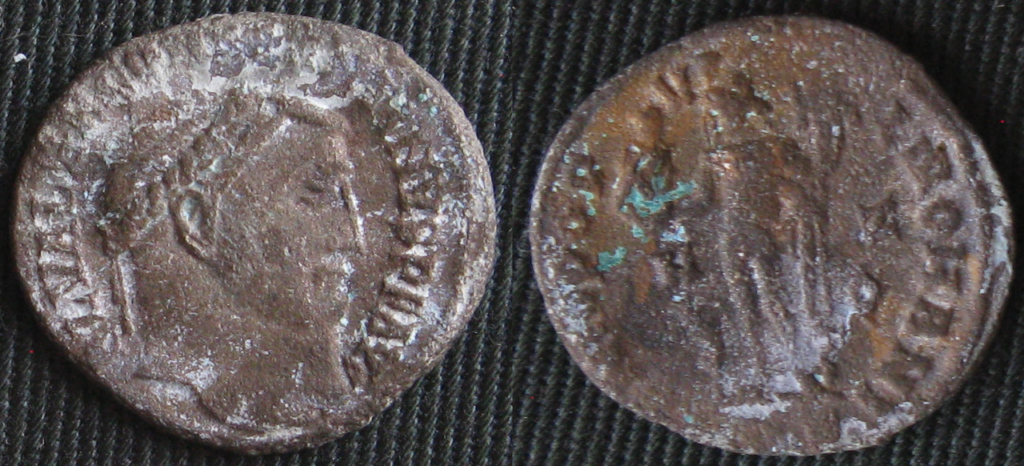
The standard chemical method is a long soak in a solution that draws chloride ions out of the metal. The classic bath is sodium sesquicarbonate — typically around 3% sodium sesquicarbonate with 2% sodium bicarbonate — in which the object may sit for weeks while the solution is changed and tested for chloride. The photograph below shows an ancient bronze coin after four weeks in exactly that treatment, with carbonate crystals forming on its surface. Distilled-water soaks work on the same principle, more slowly. The endpoint is measured, not guessed: the bath is tested until no more chloride comes out. Newer research has tested gentler alternatives, including sodium oxalate and limewater, in a 2022 study published in Environmental Science and Pollution Research — but these are still preliminary, and sesquicarbonate remains the workhorse.
Benzotriazole: the standard inhibitor, with strings attached
After the chlorides are out, conservators commonly apply benzotriazole, usually known as BTA — a corrosion inhibitor first used for bronze disease by the Danish conservator Bent Madsen in 1967 (Scott, 2002, Copper and Bronze in Art, Getty Publications). BTA bonds with the copper surface to form a protective copper-BTA complex that suppresses the reactions forming copper chlorides. A typical treatment is a long soak in a 3% solution of BTA in alcohol, sometimes for weeks, followed by a protective lacquer such as Paraloid B-72. The Cardiff team used exactly this sequence on the Bristol Museum figure: mechanical cleaning, then BTA, then lacquer.
BTA has real drawbacks, and the literature is frank about them. It is potentially carcinogenic and must be handled with care — gloves, no skin contact with alcoholic solutions, no inhaling the powder, no heating the solutions. It is also environmentally persistent, which is why researchers have spent years looking for replacements: a 2013 comparative study found that salicylaldoxime outperformed BTA under severe conditions (84% relative humidity at 38 °C), while cysteine offered an environmentally friendlier option for uncorroded or previously treated pieces. Neither has fully replaced BTA yet, and BTA does not always work — heavily contaminated objects can relapse even after treatment. Corrosion is, in this sense, a close cousin of the chemistry inside a leaking battery: once the aggressive chemistry is established, stopping it takes more than one step, as our deep dive into why alkaline batteries leak shows from a different corner of corrosion science.
Electrochemical treatment: the newer option
The newest approach is electrochemical reduction: the object is made the cathode in a controlled electrochemical cell, and the current drives chloride ions out of the corrosion layers while reducing some corrosion products back toward metal. A recent study of a late Bronze Age artefact from around 1100 BCE, found in a coastal environment, used synchrotron-based microscopy to map the corrosion first — finding nantokite locked inside deep, screened pits — and then treated it with an electrochemical method designed to push the electric field into those pits. It worked on that object, but the researchers are clear that the approach needs more development before it becomes routine. Like every other treatment, it is a tool for stabilisation, not resurrection.
Seal it — and keep watching
The final step is a barrier: a clear conservation-grade lacquer, most often Paraloid B-72, that keeps moisture and oxygen away from the surface. Then comes the part that never ends — monitoring. Treated bronzes are inspected regularly, because relapse is common and early relapse is treatable while late relapse may not be. A bronze that has had bronze disease is, in conservation terms, a patient in remission, not a patient cured. The honest summary, from the Cardiff blog, is that the conservator’s goal is not to return the object with an attractive uniform patina, but to ensure that it is stable for the future.
What to do if you find it on a coin or object you own
Bronze disease is not only a museum problem. It is the commonest serious complaint among collectors of ancient coins, and it turns up on garden bronzes, brass instruments and family heirlooms. If you spot powdery light-green spots that return after brushing, do not reach for household chemistry. Vinegar, lemon juice and commercial metal polishes attack the patina as well as the disease, and soaking in tap water adds the very chlorides you are trying to remove. Do not scrub it under a tap and do not seal it in a plastic bag with a damp cloth.
The safe first steps are the museum ones: isolate the piece from other bronzes, put it somewhere dry — a sealed container with dry silica gel is ideal — and handle it with gloves, since sweat adds chloride. Then get advice from a qualified conservator before doing anything irreversible. Many museums and conservation associations offer identification services, and a short consultation is far cheaper than a ruined coin. Anything beyond drying and isolation — soaks, BTA, electrochemical treatment — belongs in trained hands, not least because BTA carries real health risks. The single most useful thing a private owner can do is catch it early: a coin with a few small spots is treatable; a coin left in a damp drawer for a year may not be.
Why it matters
It is easy to treat bronze disease as a footnote — a specialist headache for people who look after old metal. But the stakes are the objects themselves. Bronze is humanity’s first engineered alloy, and the surviving record of the Bronze Age, the classical world and early China is disproportionately bronze: tools, weapons, vessels, statues, coins. Each one that crumbles takes with it information no other source holds — how it was cast, what it was alloyed with, whose hands made it. A corroded surface can still be read by instruments; a heap of blue dust cannot.
There is also a quieter lesson in bronze disease, and it is the reason it belongs in a chemistry deep dive rather than a conservation manual alone. The cycle is a perfect small machine: a pinch of salt, a film of water and a breath of air, turning a noble metal into dust through a loop that manufactures its own acid. Understanding it means understanding passivation and its failure, catalysis, and the way a stable-looking surface can hide an unstable interior. The same ideas explain why some metals survive centuries and others do not — and why the green on the Statue of Liberty is a shield, while the green on a diseased bronze is a warning. For the full story of that shield, and how the green minerals form in the first place, read our complete guide to why copper turns green.
Frequently asked questions
Is bronze disease contagious?
No. Bronze disease is a chemical reaction, not an infection, and it cannot spread from one object to another like a germ. But the powdery corrosion it produces is rich in chlorides, and if that dust settles on another chloride-contaminated bronze in damp air, it can feed that object’s own corrosion cycle. Museums isolate affected pieces for that reason.
Can bronze disease be cured?
No — not in the sense of restoring the metal already lost. Treatment can remove chlorides, block the reaction with inhibitors such as benzotriazole, and stabilise the object, but the damage is irreversible. A treated bronze is best thought of as in remission: stable, but needing dry storage and regular checks.
How can you tell bronze disease from patina?
Bronze disease is powdery, pale green to blue-green, patchy and slightly raised, and it returns after brushing; it usually sits over pits in the metal. Stable patina is hard, smooth, even and unchanged over time. The decisive test is for chloride: X-ray fluorescence can detect chlorine on the surface, and X-ray diffraction or Raman spectroscopy can identify the minerals directly.
What humidity stops bronze disease?
The Canadian Conservation Institute recommends storing actively corroding bronzes below 35% relative humidity, in sealed storage with conditioned silica gel. At that dryness the nantokite at the heart of the cycle cannot find the water film it needs to react. But dryness only pauses the disease — the chlorides remain inside, so the object still needs treatment before it can be displayed normally.
Is the green powder dangerous to touch?
The stable green minerals of patina — brochantite, malachite and atacamite — are not a hazard to touch in normal handling. The powder of active bronze disease is a different matter: it is a corrosive chloride dust, and it should not be inhaled or left on skin. Handle suspect objects with gloves, keep them dry and isolated, and ask a conservator before cleaning them.